
- All
- Product Name
- Product Keyword
- Product Model
- Product Summary
- Product Description
- Multi Field Search
Views: 0 Author: Rhinails Publish Time: 2026-10-27 Origin: Site


Bargain framing nails save $10 to $15 per box of 4,000, but clearing three feed jams per box costs a framing crew 15 minutes of downtime ($30 to $50 in wasted labor).
On structural inspections, undersized bargain shanks (such as 0.120 in sold as 0.131 in) fail IRC building code shear tests, forcing expensive engineering retrofits.
When factoring in gun maintenance, collation debris cleanup, and sheared heads, cheap framing nails cost double their purchase price on the jobsite.
Contractors buy nails by the box, but pay framing crews by the hour. A crew of four carpenters costs roughly $160 to $240 per hour on a residential jobsite.
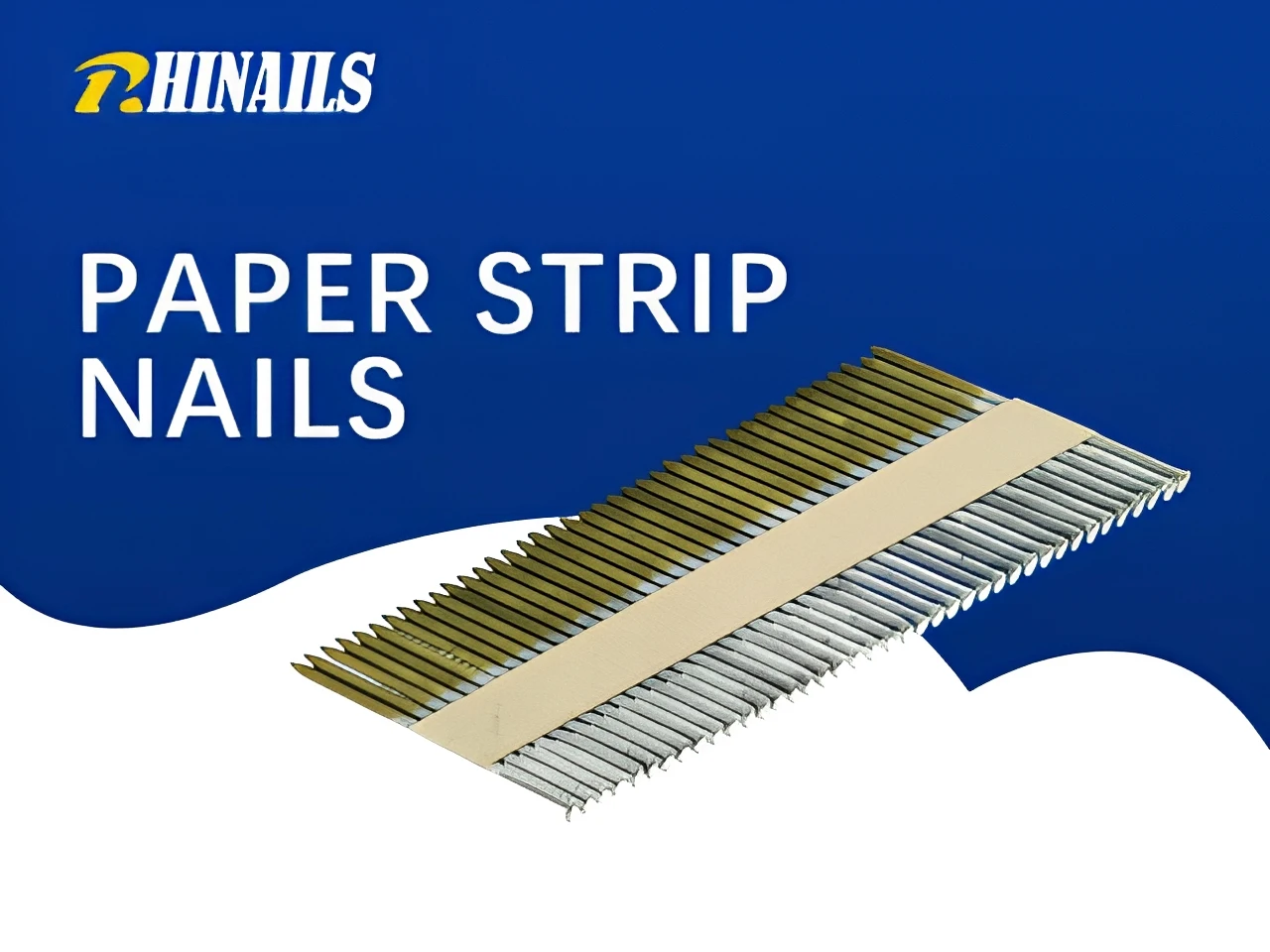
Fig. 1 - Rhinails paper strip nails: 30-degree to 34-degree paper tape collation that shears cleanly upon impact, leaving zero plastic shrapnel inside the tool magazine.
Here is how the real cost breaks down on a typical 10-box framing job:
Fastener purchase price: Saving $12 per box on 10 boxes equals $120.
Clearing magazine jams: Cheap wire burrs and uneven collation cause 3 to 5 jams per box. Clearing each jam takes 4 minutes (depressurize air hose, punch driver blade back, clear collapsed strip). That equals 120 minutes of downtime = $320 to $480 in lost carpenter labor.
Net result: The contractor saved $120 on fasteners and spent $400 in wasted wages.
Contractor forum discussions across thousands of framing jobs highlight four recurring problems with bargain fasteners:
Cheap 21-degree plastic collation uses brittle recycled PVC that shatters on impact.
Hard plastic shards fly back into the carpenter's face or wedge inside the driver nose.
The next nail feeds over plastic debris, jamming the driver blade mid-stroke.
Quality collation uses flexible polyethylene or high-resin paper tape that releases cleanly without breaking into loose flakes.
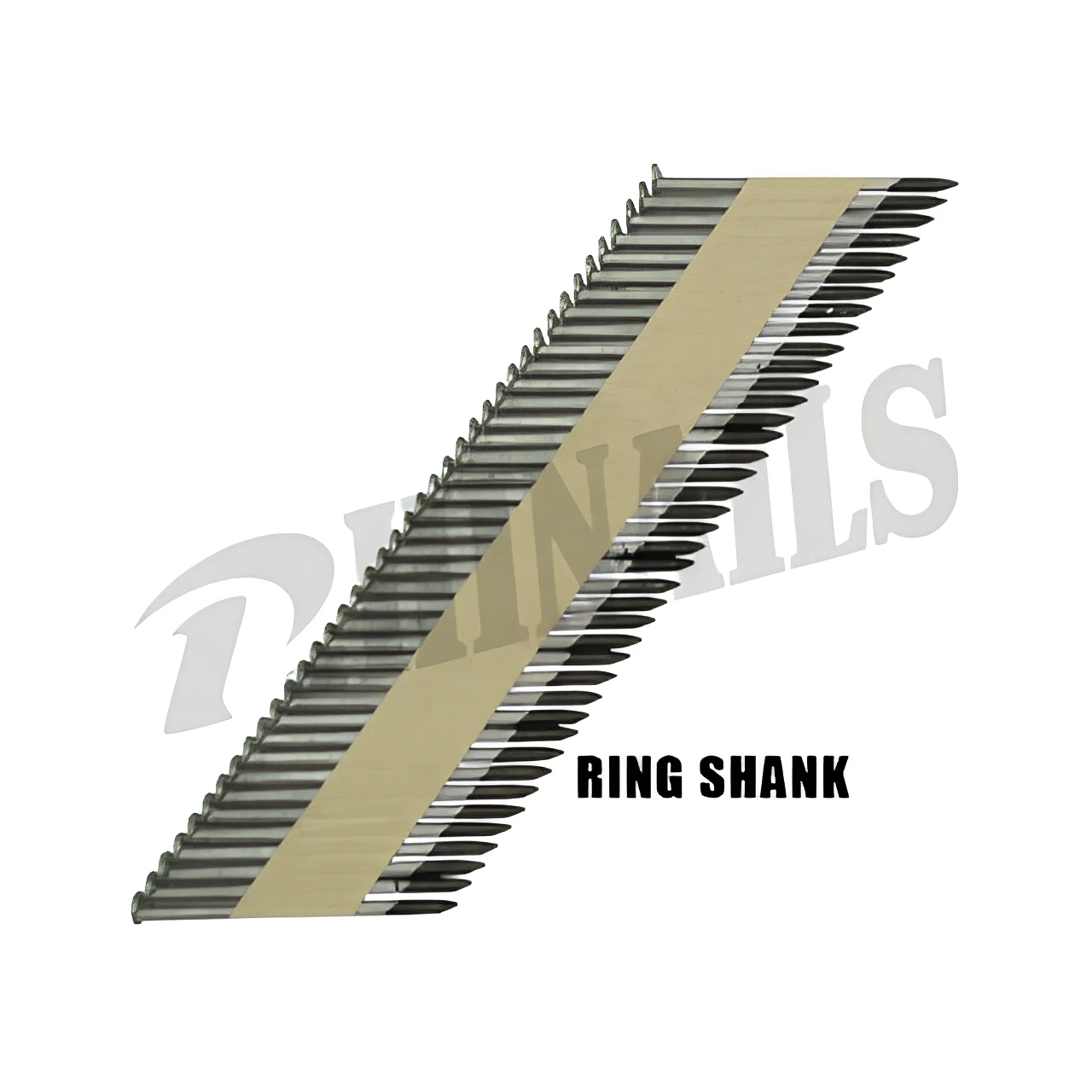
Fig. 2 - Offset round head ring shank strip nails: engineered offset geometry satisfies building code full-round-head bearing requirements while maintaining tight strip collation spacing.
To cut raw material costs, bargain manufacturers draw wire undersized:
A box labeled "16d Common" should measure 0.162 in (4.11 mm) in shank diameter.
Bargain imports frequently measure 0.131 in (3.33 mm), which is actually a 10d or 8d diameter.
Under the International Residential Code (IRC Section R602.3), structural shear walls require verified shank diameters. An inspector with a digital caliper will red-tag the frame, requiring hundreds of sistered nails or structural screws.
Low-cost factories use re-rolled scrap steel wire with uneven carbon distribution and micro-inclusions.
During high-velocity pneumatic driving into engineered lumber (LVL or LSL headers), the transition between shank and head fractures.
The nail penetrates the header, but the head pops off, leaving zero clamping force on the joist hanger.
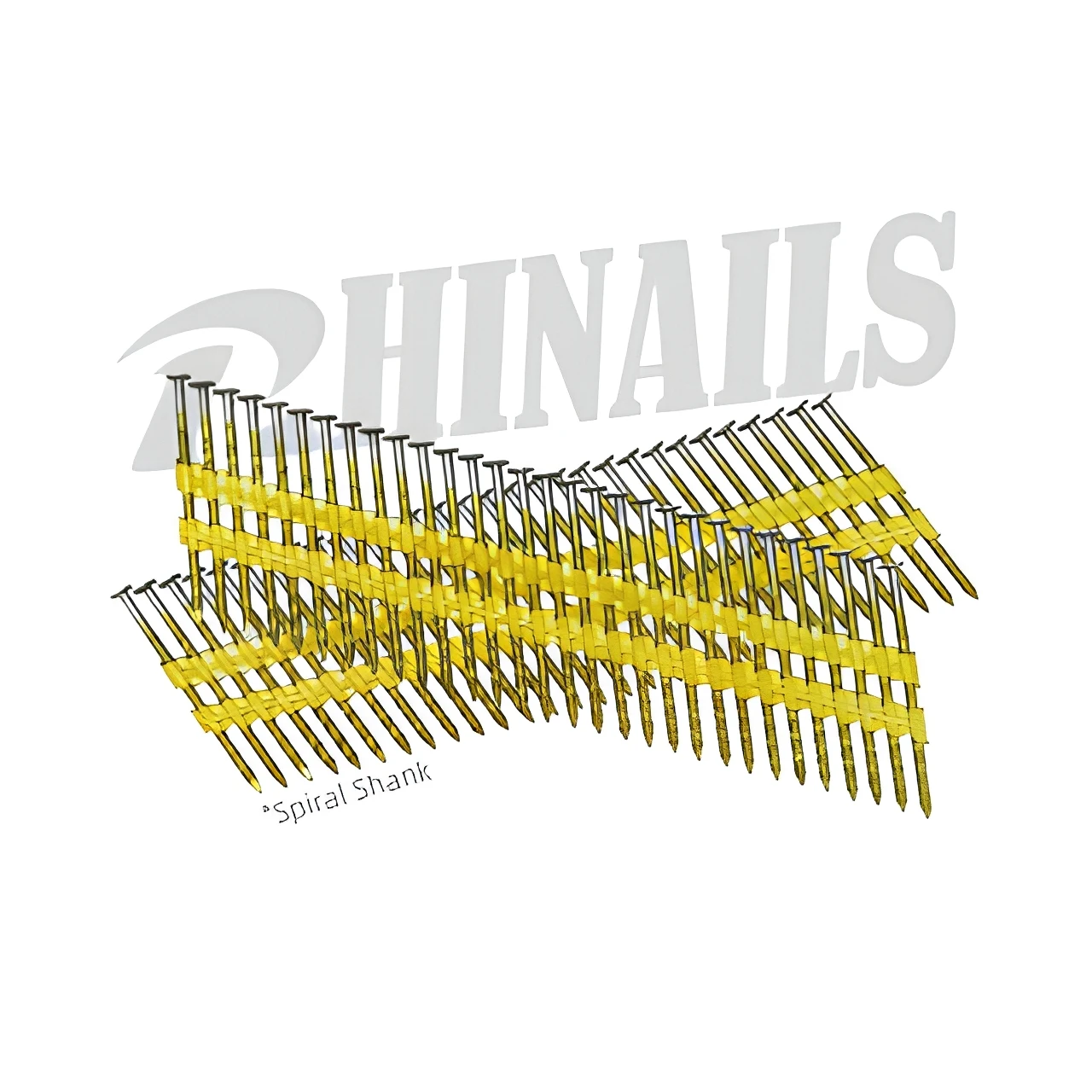
Fig. 3 - Rhinails plastic strip nails: 21-degree full round head nails with spiral and ring shanks for maximum structural withdrawal resistance in heavy framing.
Treated sill plates contain copper azole (CA-C) or alkaline copper quaternary (ACQ) preservatives that eat plain steel rapidly.
Cheap "galvanized" nails carry a flash electro-coating under 8 microns.
In contact with moist treated timber, the nail shank corrodes through in 18 to 36 months.
Building codes require hot-dip galvanized (ASTM A153 Class D, 45+ microns) or Grade 304 stainless steel for treated wood contact.
Performance Factor | Bargain / Generic Framing Nails | Rhinails Factory-Grade Framing Nails |
Shank Diameter Tolerance | Loose (+/- 0.08 mm); often undersized to save steel | Strict (+/- 0.01 mm) drawn to full ASTM F1667 spec |
Collation Reliability | Brittle plastic or dry paper; 3-5 jams per 4,000-ct box | High-tensile moisture-resistant tape; zero collation jams |
Head Centering & Integrity | Off-center stamping; risk of head snap on LVL headers | Concentric cold-forged heads; 100% full round head code compliant |
Treated Lumber Protection | Thin electro-galvanizing (5-8 um); rusts under ACQ timber | True Hot-Dip Galvanized (ASTM A153 Class D, 45-85 um) |
Building Code Compliance | No independent evaluation reports; risk of red-tagging | Full compliance with IRC Section R602.3 fastening schedules |
Collation Type | Angle & Magazine Capacity | Weather & Jobsite Pros | Weather & Jobsite Cons | Best Applications |
21-Degree Plastic Strip | 20-22 deg, holds ~60 nails | Water-resistant in driving rain; accepts full round heads | Plastic shrapnel scatters on subfloor; can sting eyes | Rough wet outdoor framing, subflooring, exterior shear walls |
30-34 Degree Paper Tape | 30-34 deg, holds ~80 nails | Compact tool nose fits between 16 in studs; clean jobsite | Paper tape weakens if left sitting in standing water | Tight corner framing, roof trusses, multi-story framing |
15-Degree Wire Coil | 15 deg, holds 225-300 nails | Massive magazine capacity; fewest reloads per hour | Heavier tool; wire collation tabs require disposal | Production framing, manufactured housing, crate assembly |
Commercial buyers and framing contractors protect their margins by checking four factory specifications before ordering container loads:
Verify Head Marking and Geometry: Full round head (FRH) nails ensure maximum clamping area against wind uplift. Clipped-head nails are prohibited in hurricane zones (Florida, coastal Carolinas).
Check Wire Tensile Strength: Structural framing wire must exceed 900 N/mm2 tensile strength to withstand high shear forces across wall plates.
Inspect Collation Peel Strength: Paper tape must peel cleanly at the shear line without separating when coils or strips drop on concrete floors.
Demand Salt Spray Testing for Exterior Lines: Require 1,000-hour ASTM B117 salt spray verification for hot-dip galvanized fasteners used in outdoor treated decks and shear panels.
30-34 degree paper tape framing nails - Paper Strip Nails Collection
21-degree plastic collated framing nails - Plastic Strip Nails Collection
High-capacity wire coil framing nails - Coil Nails Overview
Pneumatic framing and coil nailers - Rhinails Pneumatic Tool Range
All structural fasteners - Rhinails Complete Catalogue
Q: Why do cheap framing nails jam pneumatic guns so frequently?A: Bargain nails feature inconsistent wire diameters (+/- 0.08 mm variance) and brittle collation glue. Plastic shards and wire burrs jam the tight driver blade guide, causing repetitive clearance downtime. |
Q: Are clipped-head framing nails allowed by building code?A: Many jurisdictions, especially high-wind coastal zones under the International Residential Code (IRC), prohibit clipped-head nails due to reduced pull-through resistance. Full round head nails are universally accepted. |
Q: What is the difference between 21-degree and 30-degree framing nails?A: 21-degree nails use plastic collation and accept true full round heads. 30- to 34-degree nails use compact paper tape collation, allowing more nails per stick and fitting into tighter framing bays between 16 in studs. |
Q: Can I use electro-galvanized framing nails in pressure-treated wood?A: No. Preservative chemicals in ACQ treated lumber rapidly corrode thin 5-micron electro-galvanized coatings. Always use hot-dip galvanized nails (ASTM A153 Class D, 45+ microns) or Grade 304 stainless steel. |
Q: How much labor time does a single nail gun jam waste?A: A nail jam takes roughly 3 to 5 minutes to clear safely. For a 4-person framing crew billing $200/hour, three jams per box waste $30 to $50 in unbilled labor, completely erasing any initial purchase discount. |
Rhinails is a structural fastener manufacturer with 30 years of industrial export experience, supplying certified collated framing nails, coil nails, staples, and pneumatic tools to commercial lumberyards and framing contractors worldwide.
We manufacture 21-degree plastic strip nails, 30-34 degree paper tape nails, and 15-degree wire coil nails in smooth, ring, and spiral shanks with bright, electro-galvanized, and hot-dip galvanized finishes.
Every production lot undergoes rigorous shear-load verification, collation peel testing, and dimensional inspection.
Contact us to request structural nail specification sheets, factory-direct container pricing, or jobsite evaluation sample packs.


