
- All
- Product Name
- Product Keyword
- Product Model
- Product Summary
- Product Description
- Multi Field Search
Views: 0 Author: Rhinails Publish Time: 2026-11-19 Origin: Site


Never substitute roofing nails for exterior siding: oversized 3/8 in (9.5 mm) roofing nail heads crack brittle fiber cement (Hardie board) edges and leave conspicuous disks on cedar lap siding, while short 1-1/4 in roofing nails fail the mandatory 1-1/4 in (32 mm) framing stud penetration required by building codes (IRC Section R703).
Exterior siding demands 2 in to 2-1/2 in (50 mm to 64 mm) slender ring-shank coil nails (0.090 in / 0.092 in diameter) with compact 0.22 in (5.6 mm) full round heads that seat flush without fracturing the panel.
On residential construction sites, roofing coil nailers and siding coil nailers look almost identical from ten feet away. Both fire 15-degree wire-collated coils.
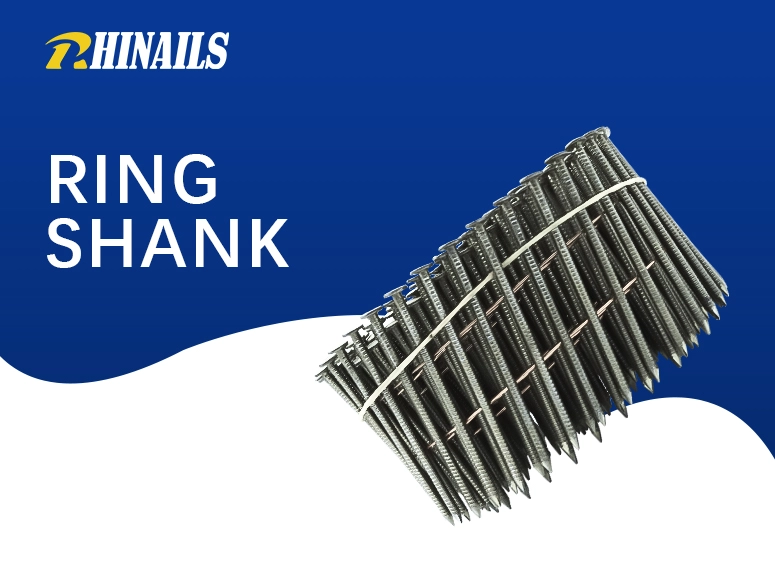
Fig. 1 - Rhinails ring shank coil nails: annular deformed rings bite into wall studs to resist cyclic wind-uplift suction forces that pull smooth fasteners loose.
Roofer-installers often attempt to use leftover 1-1/4 in roofing nails on siding to avoid buying dedicated siding coil fasteners:
A roofing nail is engineered for a completely different task: clamping thin, soft asphalt shingle fiberglass mats to 1/2 in roof deck plywood.
Siding panels are heavy, vertical, and subject to continuous lateral shear, thermal expansion, and hurricane wind suction.
Using a roofing nail on siding creates two catastrophic failures: edge blowout during driving and siding courses pulling off in windstorms.
Engineering Specification | Dedicated Coil Siding Nails | Standard Coil Roofing Nails | Why Siding Fails with Roofing Nails |
Shank Diameter (Wire Gauge) | 0.090 in to 0.099 in (13 - 14 ga / 2.3 - 2.5 mm) | 0.120 in (11 ga / 3.05 mm) | 0.120 in thick shank wedges and splits wood lap; shatters fiber cement |
Head Diameter | 0.220 in to 0.250 in (5.6 - 6.4 mm) | 0.375 in (3/8 in / 9.5 - 10 mm) | Huge 3/8 in head breaks panel edges; cannot be countersunk cleanly |
Standard Lengths | 2 in to 2-1/2 in (50 mm - 64 mm) | 1-1/4 in to 1-3/4 in (32 mm - 45 mm) | 1-1/4 in nail cannot reach wall studs through siding + 7/16 in OSB |
Shank Geometry | Annular Ring Shank or Spiral Shank | Mostly Smooth Shank (some Ring) | Smooth roofing shanks pull out of OSB under wind suction |
Pneumatic Tool Type | Siding Nailer (e.g., CN55 / CN65) | Roofing Nailer (e.g., RN46 / CN45) | Roofing gun nose is too broad for tight blind-nailing pockets |
Building Code Status (IRC R703) | Fully Approved for Siding Schedules | Prohibited on Fiber Cement & Lap Siding | Voids manufacturer warranties (James Hardie / Allura) |

Fig. 2 - Rhinails spiral shank coil nails: screw flutes rotate into framing studs, reducing driving resistance in dense timber while maximizing racking strength.
Contractor warranty investigations consistently document three failure modes when roofing nails are misapplied on siding:
Fiber cement is a dense composite of Portland cement, sand, and cellulose fibers. It has high compressive strength but low flexural ductility:
When a thick 0.120 in roofing nail hits the board within 1 inch of the top edge, the wedge action shatters the cement matrix.
The oversized 3/8 in head crushes the top blind-nailing zone, blowing out an irregular crater.
The fastener loses its clamping shoulder, leaving the heavy siding board hanging by friction alone.
Building codes (IRC Section R703) require siding fasteners to penetrate at least 1-1/4 in (32 mm) into solid wood framing studs:
Consider a standard wall cross-section: Siding board (5/16 in to 1/2 in) + Weather resistive barrier + OSB sheathing (7/16 in) = roughly 7/8 in to 1 in of non-structural buildup.
If an installer shoots a 1-1/4 in roofing nail, only 1/4 in of nail tip enters the 2x4 stud.
The nail holds only in the crumbly 7/16 in OSB sheathing. During a 70 mph windstorm, wind suction pulls the entire siding wall off the house in sheets.
Sourcing ASTM-Certified Coil Siding Nails Direct from Factory?Rhinails manufactures 15-degree wire-collated and plastic-sheet coil siding nails in 0.090" and 0.092" ring and spiral shanks with hot-dip galvanized (ASTM A153 Class D) and Grade 304/316 stainless finishes. Request a Siding Fastener Specification Sheet & Free Jobsite Sample Pack -> |
Where face nailing is required (such as under window sills and at the top course):
Siding nails have small, checker-patterned full round heads that accept exterior paint and blend into wood grain.
A roofing nail leaves a massive, gleaming 3/8 in disc sitting proud on the siding surface that cannot be concealed with caulk or paint.

Fig. 3 - Rhinails smooth shank coil nails: while smooth shanks suit dry interior crating, exterior siding mandates annular ring shanks to resist wind-uplift withdrawal.
Siding Material Type | Board Thickness | Fastener Nailing Method | Recommended Siding Nail Spec | Minimum Nail Length | Required Coating |
Fiber Cement Lap (HardiePlank) | 5/16 in (8 mm) | Blind Nailing (top edge) | 0.090 in / 0.092 in Ring Shank | 2 in to 2-1/4 in (50-57 mm) | Hot-Dip Galvanized / 304 SS |
Fiber Cement Lap (Face Nailing) | 5/16 in (8 mm) | Face Nailing (exposed) | 0.090 in Ring Shank (Checker Head) | 2-1/2 in (64 mm) | Hot-Dip Galvanized / 304 SS |
Western Red Cedar Lap Siding | 1/2 in to 3/4 in | Face Nailing | 0.090 in Ring Shank (Casing Head) | 2-1/2 in (64 mm) | Grade 304 or 316 Stainless |
Engineered Wood (LP SmartSide) | 3/8 in to 7/16 in | Blind Nailing | 0.092 in or 0.113 in Ring Shank | 2 in to 2-1/2 in (50-64 mm) | Hot-Dip Galvanized (ASTM A153) |
Vinyl Siding | 0.040 in to 0.046 in | Hang in center of slots | 0.120 in Smooth Roofing (Loose Hang) | 1-1/2 in (38 mm) | Hot-Dip Galvanized (Slot-Only) |
Thirty years of industrial coil nail manufacturing highlights four technical controls commercial buyers should verify:
True Slender Shank Diameter (0.090 in / 2.3 mm): Reject oversized wire that splits cedar and fiber cement. Rhinails draws high-tensile wire through diamond dies holding +/-0.01 mm tolerance.
Compact Full Round Head Geometry (5.6 - 6.4 mm): Heads must be concentric to ensure pneumatic driver blades strike flat without tearing the top board edge.
ASTM A153 Class D Hot-Dip Galvanizing: Siding fasteners are exposed to exterior rain and wind-driven moisture. Nails must carry at least 45 microns of zinc to match 30-year siding warranties.
Clean 15-Degree Wire Collation: Collation weld wires must shear cleanly without leaving sharp metal flags sticking out from the nail head on finished siding walls.
Ring shank coil siding nails - Ring Shank Coil Nails Collection
Spiral shank coil siding nails - Spiral Shank Coil Nails Collection
Full coil nail catalogue - Coil Nails Overview
Pneumatic siding and coil nailers - Coil Nailer Range
Complete fastener collections - All Rhinails Products
Q: Can I use roofing nails to install fiber cement siding?A: No. Fiber cement manufacturers (like James Hardie) explicitly prohibit roofing nails. The large 3/8 in head and thick 0.120 in shank crack the cement board, and the short length voids the product warranty. |
Q: What size nails should be used for James Hardie lap siding?A: Use 0.090 in or 0.092 in shank diameter, 2 in to 2-1/4 in long ring-shank siding nails with a 0.22 in full round head. The nail must penetrate at least 1-1/4 in into wood wall studs. |
Q: Can roofing nails be used for vinyl siding?A: Vinyl siding is the only exception where large roofing nail heads are permitted, because the nail is hung loose in the center of the slot to allow thermal expansion, rather than clamping the vinyl tight. |
Q: Why do cedar siding boards need stainless steel nails?A: Cedar contains high levels of natural tannic acid. When standard galvanized nails are used, tannic acid reacts with iron to produce dark, ugly black streaks that permanently stain the wood. |
Q: What is the difference between blind nailing and face nailing siding?A: Blind nailing places the fastener along the top edge of the board so the overlapping upper course hides the nail head. Face nailing drives the nail through the visible bottom edge of the board. |
Rhinails is a high-volume coil fastener manufacturer with 30 years of industrial export experience, supplying certified 15-degree coil siding nails, roofing fasteners, framing nails, and pneumatic tools to building contractors, lumberyards, and exterior cladding distributors worldwide.
We produce 0.090 in and 0.092 in slender siding nails in ring, spiral, and smooth shanks with hot-dip galvanized (ASTM A153 Class D) and Grade 304/316 stainless steel finishes engineered to IRC Section R703 building codes.
Every production lot undergoes strict shank tolerance inspection, pull-through withdrawal verification, and salt spray testing.
Contact us to request technical specification sheets, container-load wholesale pricing, or jobsite evaluation sample packs.


