
- All
- Product Name
- Product Keyword
- Product Model
- Product Summary
- Product Description
- Multi Field Search
Views: 0 Author: Rhinails Publish Time: 2026-11-17 Origin: Site


Corrugated fasteners (such as Rhinails 5-wave carbon steel joint nails, 0.63 mm thickness, 3/8 in and 1/2 in lengths) reinforce wooden miter and butt joints in under two seconds without pre-drilling, dowel jigs, or overnight clamping, using an alternating wave wedge geometry that mechanically draws timber seams tight together under driving impact while delivering superior racking shear resistance in cabinet face frames, picture moldings, window screens, and wooden pallet repairs.
A 45-degree miter joint joins two pieces of wood along their end-grain. Because end-grain absorbs wood glue like a sponge, a glued miter joint has almost zero tensile strength on its own.
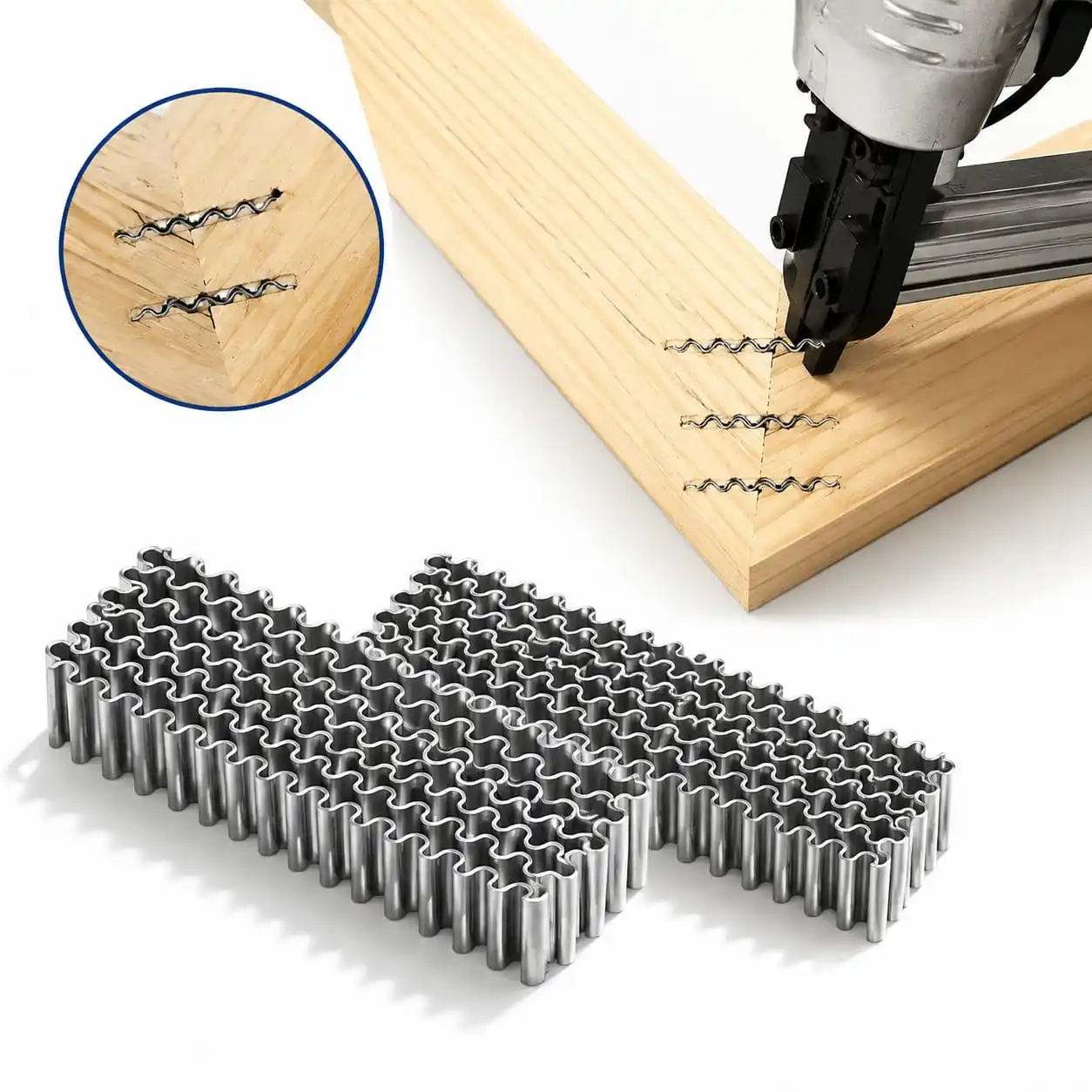
Fig. 1 - Rhinails 5-wave corrugated fasteners: pneumatic corrugated nail gun driving hardened 0.63 mm steel flutes across a 45-degree miter joint, clamping the seam tight in a single trigger pull.
Woodworkers traditionally reinforce miters using three slow methods:
Wood biscuits: Requires a dedicated biscuit joiner, precise slot alignment, glue application, and 30 minutes in corner clamps.
Dowels: Requires precision dowel jigs, drilling, gluing, and clamping. Any 0.5 mm drill drift misaligns the frame faces.
Pocket hole screws: Requires drilling angled pocket holes and driving screws, leaving large oval holes that must be plugged on finished surfaces.
In high-volume commercial shops, waiting for glue to dry in four corner clamps throttles production. Corrugated fasteners solve this bottleneck by functioning as a permanent, instant mechanical clamp.
A corrugated fastener is a ribbon of cold-rolled high-carbon steel formed with alternating sinusoidal waves:
One edge is ground into a razor-sharp continuous chisel bevel to penetrate wood fibers cleanly.
The alternating flutes act as inclined wedges facing inward toward the center seam.
As a pneumatic driver drives the fastener across a miter or butt joint, the wave angles compress the wood fibers on both sides of the joint, drawing the two pieces of timber tightly together.
The fastener embeds flush into the back or hidden face of the frame, leaving the front display face pristine.
Joint Fastening Method | Assembly Time per Joint | Tooling Required | Clamping Required? | Self-Clenching Action? | Front Face Appearance | Best Application |
5-Wave Corrugated Fasteners | 1 to 2 seconds | Pneumatic corrugated nailer | No (instant mechanical lock) | Yes (waves pull seam tight) | 100% clean (driven on rear) | Picture frames, cabinet doors, window screens, pallet repair |
Wood Biscuits (#20 / #10) | 2 to 3 minutes | Biscuit joiner, wood glue | Yes (30+ min clamp time) | No (requires bar clamps) | Clean (hidden inside joint) | Fine furniture casework, tabletop edge-gluing |
Pocket Hole Screws | 1 to 2 minutes | Pocket hole jig, drill, driver | Yes (face clamp during drive) | Pulls joint (can shift face) | Large oval holes on rear face | Cabinet face frames, utility shelving, rough casework |
Wooden Dowels | 3 to 4 minutes | Dowel jig, drill, glue | Yes (45+ min clamp time) | No (requires bar clamps) | Clean (hidden inside joint) | Heavy chair legs, structural table aprons |

Fig. 2 - Industrial applications: Rhinails corrugated fasteners locking miters on modular furniture, bathroom vanities, and cabinet doors with zero front-face fasteners.
Commercial woodworking shops rely on corrugated joint nails for four high-speed assemblies:
Miters on pre-finished picture frame moldings cannot tolerate clamp pressure marks or glue squeeze-out.
The frame is assembled face-down in an L-shaped corner jig.
A single corrugated fastener driven across the rear miter locks the joint permanently.
The frame can be handled, glazed, and packed immediately without waiting for glue to cure.
Cabinet shops join 3/4 in stiles and rails with corrugated fasteners on the back side:
Resists diagonal racking forces when cabinet doors are opened and closed thousands of times.
Eliminates the need for expensive pocket hole plugging on visible interior cabinet faces.
Sourcing 5-Wave Corrugated Fasteners Direct from Factory?Rhinails manufactures 3/8 inch (9mm) and 1/2 inch (12mm) 5-wave corrugated fasteners in high-carbon steel with 40g/m2 galvanizing, compatible with standard pneumatic W and CF nailers. |
Thin 1/2 in or 5/8 in softwood frames split easily when nailed from the edge.
Corrugated fasteners drive flat into the face across the corner.
The wide 25 mm span bridges across grain lines without splitting fragile corners.
In logistics warehouses, broken pallet deck boards and crate corners can be spliced in seconds:
Driving corrugated fasteners across split timber boards restores structural integrity without dismantling the pallet.
Extends the service life of shipping crates at a fraction of replacement cost.
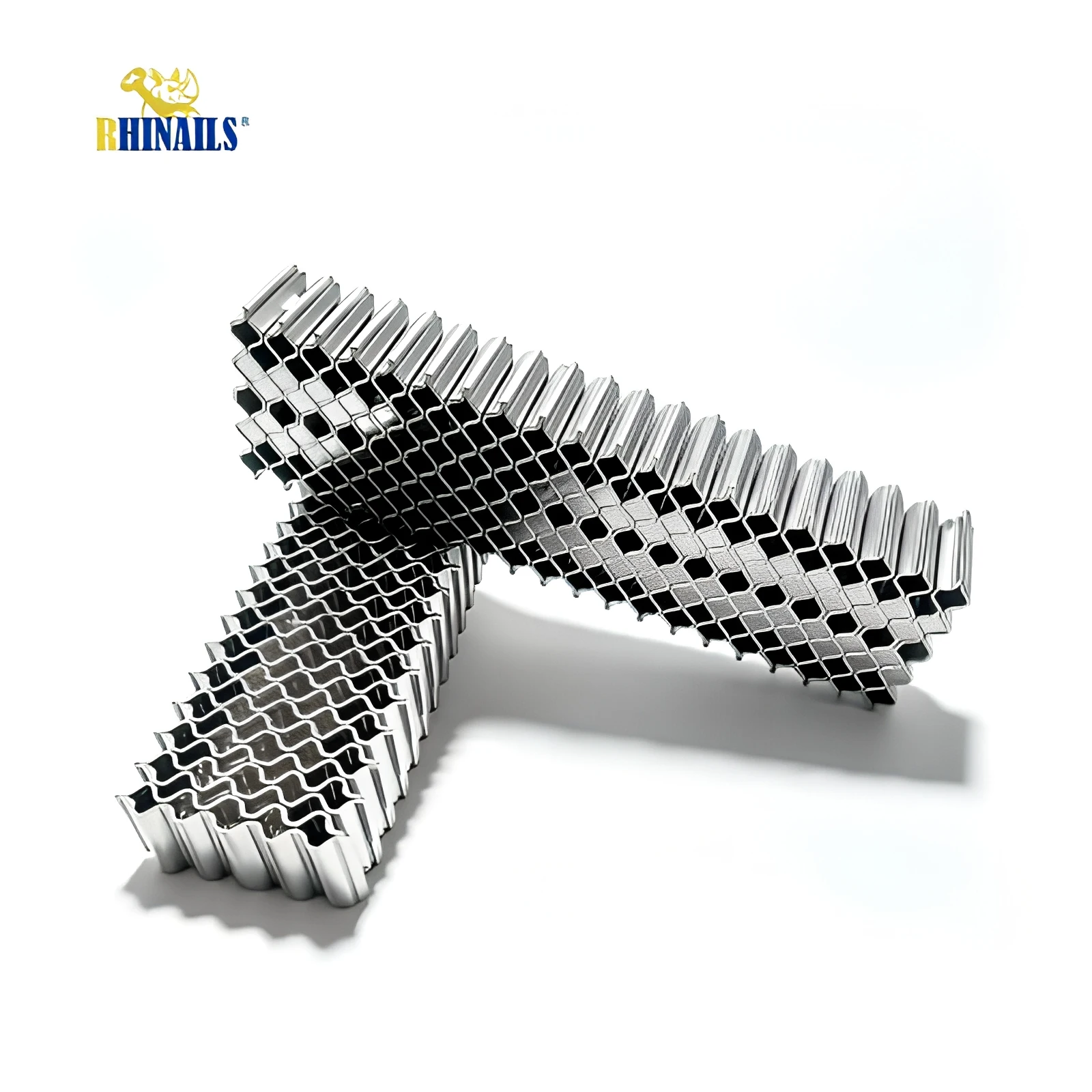
Fig. 3 - Rhinails 5-wave corrugated fastener strips: cold-formed from high-tensile 0.63 mm steel strip with uniform wave pitch and heavy 40g/m2 zinc coating for rust-free interior and exterior millwork.
Fastener Length (Model) | Wave Profile | Width Across Waves | Steel Thickness | Timber Thickness Range | Best Application |
3/8 Inch (9 mm) - CF09 | 5-Corrugation Wave | 25.0 mm (1.0 in) | 0.63 mm | 1/2 in to 3/4 in (12-19 mm) | Picture frames, cabinet doors, screen frames, small boxes |
1/2 Inch (12 mm) - CF12 | 5-Corrugation Wave | 25.0 mm (1.0 in) | 0.63 mm | 3/4 in to 1-1/2 in (19-38 mm) | Heavy cabinet face frames, truss gussets, pallet deck repairs |
5/8 Inch (15 mm) - CF15 | 5-Corrugation Wave | 25.0 mm (1.0 in) | 0.63 mm | 1-1/4 in to 2 in (32-50 mm) | Heavy timber crating, agricultural bin construction |
Center the Fastener over the Seam: Position the middle wave directly over the joint line so equal steel engages both pieces of wood.
Drive from the Hidden Face: Always shoot fasteners into the back of picture frames, inside face of cabinet doors, or underside of moldings.
Set Proper Pneumatic Air Pressure (70 to 90 PSI): Over-driving embeds the fastener too deeply, crushing surface fibers; under-driving leaves the top edge proud.
Use Glue for Permanent Structural Joints: For furniture that experiences continuous handling, apply a dab of wood glue along the miter before driving the corrugated fastener. The fastener acts as an unyielding clamp while the glue cures.
Thirty years of precision fastener manufacturing highlights four benchmarks commercial buyers should verify:
Uniform 0.63 mm Wire Thickness: Undersized scrap steel wire bends upon impact when driven into dense hardwoods like oak or maple.
Razor-Sharp Chisel Bevel: Symmetrical bevel grinding ensures the fastener enters wood straight without steering off-axis.
Heavy Zinc Galvanizing (Up to 40g/m2): Prevents dark rust bleed through painted cabinet frames and bathroom vanity joints.
Rigid Collation Glue Bond: Strips must flex without crumbling in tool magazines, holding +/-0.02 mm pitch consistency across all fasteners.
5-wave corrugated joint fasteners (3/8" & 1/2") - Rhinails Products Overview
18-gauge F-series brad nails - F-Series Brad Nails Collection
20-gauge 4J narrow crown staples - 4J-Series Staples Collection
22-gauge 10F fine wire staples - 10F-Series Staples Collection
Complete fastener catalogue - All Rhinails Fastener Collections
Q: How do corrugated fasteners pull miter joints tight?A: The alternating sinusoidal wave flutes act as inclined wedges. As the fastener enters the wood under pneumatic impact, the angles of the waves draw the two pieces of timber inward toward the seam. |
Q: Are corrugated fasteners stronger than pocket screws?A: Pocket screws provide higher tensile pull-apart strength in thick lumber, but corrugated fasteners provide superior racking shear resistance in thin miters (like picture frames and cabinet doors) with zero clamp wait time. |
Q: What pneumatic tool is needed to fire corrugated fasteners?A: Corrugated fasteners require a dedicated pneumatic corrugated nailer (such as W-series or CF-series tools). They operate on standard shop air at 70 to 90 psi and fire collated strips. |
Q: Will corrugated fasteners split hardwood?A: Quality corrugated fasteners feature sharp beveled chisel edges that slice across wood fibers rather than wedging them apart. In dense hardwoods like oak, they drive cleanly without splitting. |
Q: Can corrugated fasteners be used outdoors?A: Yes, provided they carry heavy zinc galvanizing. Rhinails corrugated fasteners carry up to 40g/m2 zinc coating, protecting them against humidity in outdoor window screens, wooden gates, and shipping crates. |
Rhinails is an industrial fastener manufacturer with 30 years of global export experience, supplying precision 5-wave corrugated joint fasteners, collated staples, finish brads, and pneumatic tools to commercial millwork factories, cabinetmakers, and hardware distributors worldwide.
We produce 3/8 in (9 mm) and 1/2 in (12 mm) corrugated fasteners cold-formed from high-tensile 0.63 mm carbon steel with heavy 40g/m2 galvanizing, compatible with all standard W and CF pneumatic tools.
Every production lot undergoes rigorous wave-pitch tolerance inspection, bevel sharpness checks, and pneumatic cycling verification.
Contact us to request technical specification sheets, container-load wholesale pricing, or jobsite evaluation sample packs.


