
- All
- Product Name
- Product Keyword
- Product Model
- Product Summary
- Product Description
- Multi Field Search
Views: 0 Author: Rhinails Publish Time: 2026-11-04 Origin: Site


Choose a 16-gauge finish nailer (T-series, 1.6 mm wire) for structural trim that carries weight, such as solid wood door jambs, exterior door casings, thick baseboards (over 1/2 in), and stair treads.
Choose an 18-gauge brad nailer (F-series, 1.2 mm wire) for lighter decorative trim like quarter-round shoe molding, thin window stops, picture frames, and cabinet face frames, where a heavy nail would split delicate hardwood.
When fixing baseboards or furring directly to concrete or masonry walls, step up to hardened ST-series 55# steel brad nails.
Wire gauge numbers work in reverse: an 18-gauge nail is noticeably thinner than a 16-gauge nail.
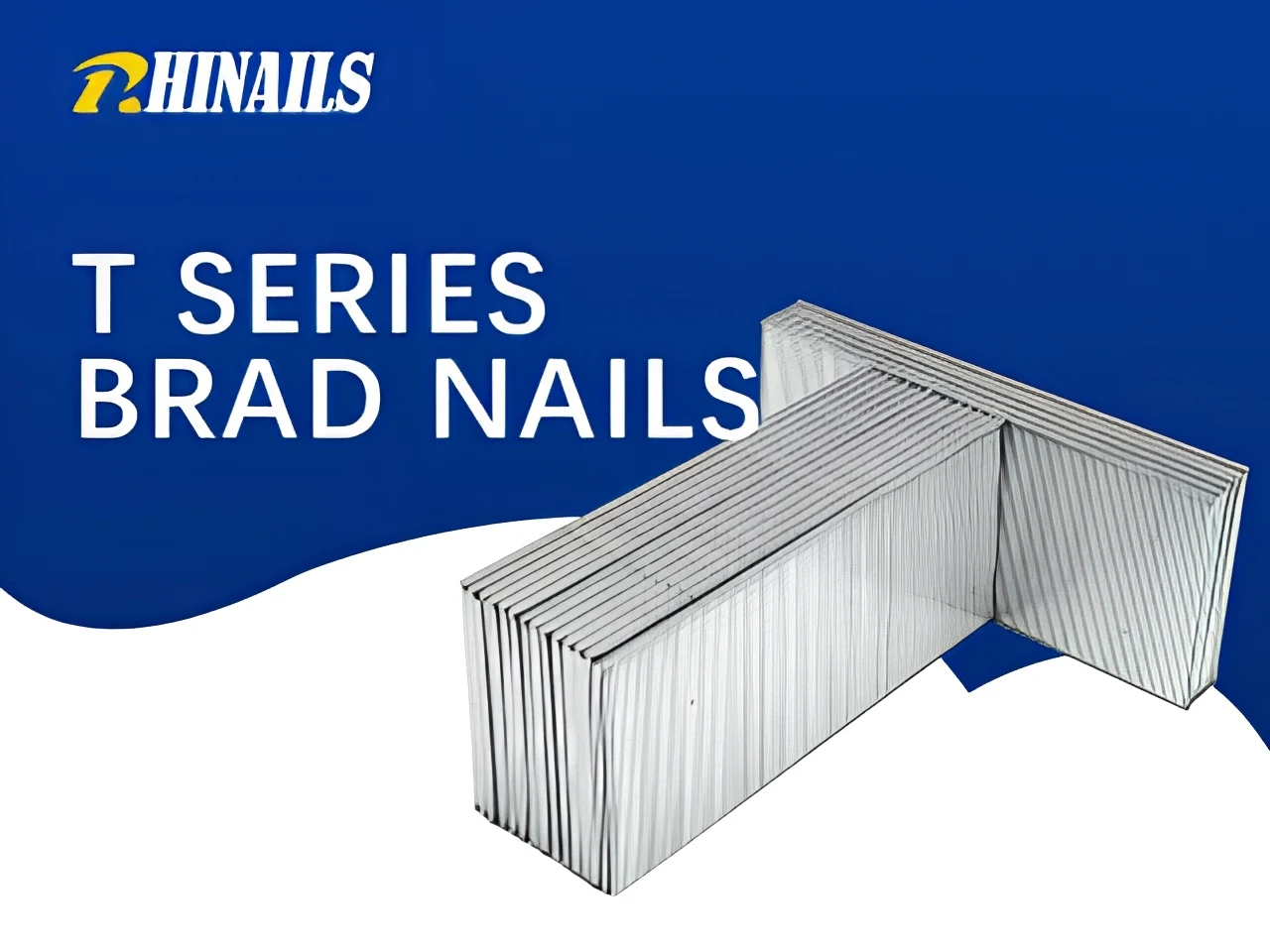
Fig. 1 - Rhinails T-series 16-gauge finish nails: 1.60 mm wire diameter with a defined T-head delivers high structural shear resistance for door frames and heavy baseboards.
That 0.4 mm difference between 1.20 mm (18 ga) and 1.60 mm (16 ga) creates a 77% increase in steel cross-sectional area:
16-Gauge (T-Series): Provides true mechanical holding power. It resists lateral racking and pull-through when solid doors slam repeatedly.
18-Gauge (F-Series): Focuses on clean cosmetics. It leaves a pin-sized entry hole that requires minimal wood putty and does not split narrow moldings.
Fastener Specification | 16-Gauge Finish Nails (T-Series) | 18-Gauge Brad Nails (F-Series) | ST-Series Hardened Concrete Brads |
Wire Diameter | 1.60 mm (0.063 in) | 1.20 mm (0.047 in) | 2.20 mm (0.087 in) |
Head Style | T-shaped head (1.6 x 2.8 mm) | Small rectangular F-head (1.2 x 2.0 mm) | T-head with reinforced shoulder |
Holding Role | Structural clamping & shear grip | Light mechanical hold & cosmetic pinning | High-strength masonry anchoring |
Hole Size in Wood | Requires color-matched wood filler | Tiny hole; easily bridged by primer / wax | Larger hole; intended for covered trim |
Splitting Tendency | Can split moldings under 1/2 in thick | Low splitting risk in fine hardwood | Drives into masonry / wood without pre-drilling |
Available Lengths | 20 mm to 64 mm (3/4 in to 2-1/2 in) | 10 mm to 50 mm (3/8 in to 2 in) | 18 mm to 64 mm (3/4 in to 2-1/2 in) |
Standard Steel Grade | High-tensile carbon steel (bright / zinc) | High-tensile carbon steel (bright / zinc) | 55# Quenched high-carbon steel (HRC 50-54) |

Fig. 2 - Rhinails F-series 18-gauge brad nails: slender 1.20 mm shank drives cleanly into narrow shoe molding and cabinet face frames without splitting fragile edges.
An 18-gauge brad nailer is the primary finish carpentry tool for trim that does not carry heavy weight:
Shoe molding & quarter-round: Thin 1/2 in profiles split instantly under 16-gauge nails; 18-gauge pins them cleanly to baseboards.
Crown molding corner miters: Pinning delicate outside corners while wood glue sets.
Window casing reveals: Tacking decorative window stops without leaving large putty holes.
Cabinetry & drawer boxes: Assembling 1/4 in plywood drawer bottoms and decorative furniture appliques.
An 18-gauge nail will fail when subjected to continuous movement or heavy material tension:
Pre-hung door jambs: A solid core interior door weighs 60 to 90 lbs. Slamming vibrations will pull 18-gauge brads right out of 2x4 studs. 16-gauge nails are mandatory.
Thick baseboards (5/8 in to 3/4 in): Heavy MDF or solid pine baseboards require 16-gauge nails (2 in or 2-1/2 in long) to pull the board tight against wavy drywall studs.
Stair risers & tread scotia: Foot traffic applies repeating shear forces that shear slender 18-gauge wire.
Exterior window & door trim: Exterior PVC or cedar trim expands and contracts with weather, requiring 16-gauge holding power.
Sourcing Commercial Finish Nails Direct from the Factory?Rhinails manufactures full-range F-series (18ga), T-series (16ga), and hardened ST-series masonry brads with strict +/- 0.01 mm dimensional tolerances and jam-free collation tape. |
A common jobsite dilemma occurs when installing wood baseboards or furring strips directly against concrete foundation walls, brick, or cinder block.

Fig. 3 - Rhinails ST-series concrete brad nails: forged from 55# high-carbon steel with HRC 50-54 hardness, driving through wood trim directly into concrete block without pre-drilling.
Standard carbon steel 16ga or 18ga nails bend instantly upon hitting masonry:
Standard finish wire lacks the core hardness to penetrate cured concrete aggregate.
Contractors often waste hours pre-drilling holes and inserting plastic anchors.
The professional fix is the ST-series brad: forged from quenched 55# carbon steel with a heavy 2.2 mm shank.
Using an ST pneumatic concrete nailer, you can pin 1x3 furring strips or baseboards directly into cinder block in a single trigger pull.
Wood Trim Application | Trim Thickness | Recommended Nail Gauge | Recommended Nail Length |
Quarter-Round / Shoe Molding | 3/8 in to 1/2 in (10-12 mm) | 18-Gauge (F-Series) | 1-1/4 in to 1-1/2 in (32-38 mm) |
Window Stops & Glazing Bead | 1/4 in to 3/8 in (6-10 mm) | 18-Gauge (F-Series) | 1 in to 1-1/4 in (25-32 mm) |
Cabinet Face Frames & Trim | 1/2 in to 3/4 in (12-19 mm) | 18-Gauge (F-Series) | 1-1/2 in (38 mm) |
Interior Door Casings | 5/8 in to 3/4 in (16-19 mm) | 16-Gauge (T-Series) | 2 in to 2-1/2 in (50-64 mm) |
Baseboards over Drywall | 1/2 in to 3/4 in (12-19 mm) | 16-Gauge (T-Series) | 2 in to 2-1/2 in (50-64 mm) |
Baseboards to Concrete Block | 1/2 in to 3/4 in (12-19 mm) | ST-Series Concrete Brads | 1-1/2 in to 2 in (38-50 mm) |
Stair Risers to Framing | 3/4 in (19 mm) solid stock | 16-Gauge (T-Series) | 2-1/2 in (64 mm) |
Thirty years of collated wire manufacturing highlights four technical controls commercial buyers should verify:
Wire Gauge Uniformity (+/- 0.01 mm): Oversized finish wire jams narrow nose tracks; undersized wire allows nails to tilt, creating crescent-shaped strike marks on trim.
Head Centering & Stamping: T-heads must be precisely centered over the wire shank so pneumatic driver blades deliver balanced impact without bending the nail shank.
Flexible Micro-Glue Collation: Collation adhesive must release cleanly on impact without leaving gummy residues inside the driver nose guide.
Electro-Zinc Flashing: Even indoor brads require uniform zinc plating to prevent rust spotting in high-humidity shipments or tannin reactions with damp oak.
23-Gauge Pin Nailer Safety & Deflection: Why Pins Curl in Hardwood
Cordless Nailer Won't Sink Nails? Diagnostic Troubleshooting Guide
16-gauge heavy finish nails (20-64 mm) - T-Series Brad Nails Collection
18-gauge precision brad nails (10-50 mm) - F-Series Brad Nails Collection
Hardened steel masonry brads (18-64 mm) - ST-Series Steel Brad Nails
Narrow-crown joinery staples - 4J-Series Staples Collection
Complete brad nail catalogue - Rhinails Brad Nails Range
Q: Can I use an 18-gauge brad nailer for installing baseboards?A: Only for thin MDF baseboards under 1/2 in. For solid wood or thicker baseboards (5/8 in to 3/4 in), use 16-gauge nails. 18-gauge brads lack the holding power to pull bowed boards tight against drywall studs. |
Q: Will a 16-gauge finish nailer split small shoe molding?A: Yes. The 1.6 mm diameter shank of a 16-gauge nail often splits delicate 1/2 in quarter-round and shoe molding, especially in brittle hardwoods like oak. Always switch to 18-gauge brads for small profiles. |
Q: If I can only buy one nail gun, should I get 16-gauge or 18-gauge?A: For general home renovation, an 18-gauge brad nailer covers about 70% of trim tasks, cabinetry, and crafts. However, if your primary project is hanging pre-hung doors and installing heavy baseboards, a 16-gauge nailer is essential. |
Q: How do ST-series concrete brad nails differ from standard T-nails?A: Standard T-nails are forged from mild carbon steel for wood-to-wood joinery. ST-series brads are forged from 55# high-carbon steel quenched to HRC 50-54, allowing them to penetrate concrete block and brick without bending. |
Q: Do 18-gauge brad nail holes require wood filler?A: Yes, but minimally. The entry hole is just 1.2 mm across, requiring a tiny dab of color-matched wood putty or wax stick. A 16-gauge nail leaves a larger indentation that requires full putty application and sanding. |
Rhinails is a precision fastener manufacturer with 30 years of industrial production experience, supplying high-grade collated brad nails, finish nails, staples, and pneumatic nailers to commercial millwork shops and hardware distributors worldwide.
We produce 18-gauge F-series brads, 16-gauge T-series finish nails, and hardened ST-series masonry brads with clean galvanized and bright steel finishes.
Every production lot undergoes strict dimensional tolerance inspection, collation flex testing, and drive-penetration checks.
Contact us to request fine-finish fastener specification sheets, container-load wholesale pricing, or evaluation sample packs.


