
- All
- Product Name
- Product Keyword
- Product Model
- Product Summary
- Product Description
- Multi Field Search
Views: 0 Author: Rhinails-Z Publish Time: 2026-10-14 Origin: Site


Use coarse-thread drywall screws for wood studs and fine-thread drywall screws for light-gauge steel framing.
Mixing them up causes two classic site failures: coarse threads strip out thin steel, while fine threads slip inside softwood and pull free under hammer claws. For 1/2 in drywall on 2x4 wood studs, choose #6 x 1-1/4 in coarse-thread bugle head screws.
For 20- to 25-gauge metal studs, choose #6 x 1-1/4 in fine-thread twin-lead screws.
Drywall itself is just gypsum core between paper liners. The screw threads do not grip the drywall; they anchor into the framing behind it.
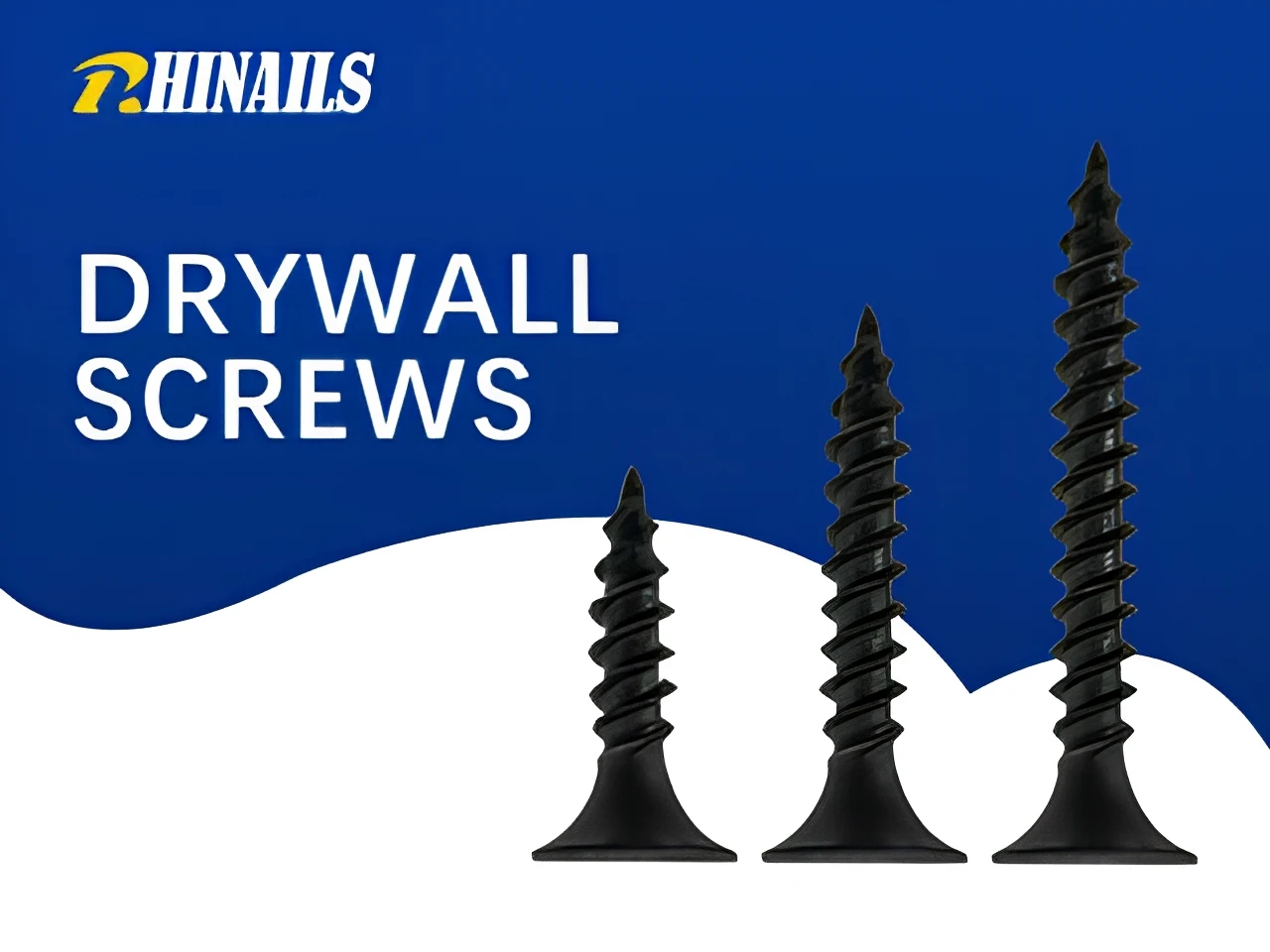
Fig. 1 - Rhinails drywall screws collection: cold-forged from 1022A carbon steel with sharp bugle heads and deep Phillips drives.
Match the thread pitch to your framing material:
Wood studs (2x4 / 2x6 timber): Coarse thread. Wide-spaced, deep ridges grab raw wood fibers and resist pull-out.
Metal studs (20 to 25 gauge steel): Fine thread. Compact twin-lead threads tap clean threads into thin sheet steel without stripping.
Heavy metal studs (12 to 18 gauge steel): Self-drilling (Tek point) drywall screws. Standard sharp points cannot pierce structural steel above 20 gauge.
Feature / Specification | Coarse-Thread Drywall Screws | Fine-Thread Drywall Screws |
|---|---|---|
Thread pitch | 8 to 9 threads per inch (wide spacing) | 14 to 16 threads per inch (compact spacing) |
Lead style | Single-lead thread | Twin-lead (double) thread for rapid steel entry |
Point style | Sharp piercing point (Type S) | Extra-sharp needle point to start on steel |
Intended framing | Softwood studs (SPF, Pine, Fir), OSB, plywood | Light-gauge steel studs (20-25 ga, 0.5-0.8 mm) |
What happens if misapplied? | Strips out thin steel holes; spins freely | Low pull-out strength in wood; can be pulled by claw hammer |
Standard sizes | #6 x 1-1/4 in, #6 x 1-5/8 in, #8 x 2 in | #6 x 1-1/4 in, #6 x 1-5/8 in |
Standard finish | Black phosphate or grey phosphate | Black phosphate or bright zinc |
Fine threads have tiny ridges spaced closely together. When driven into softwood:
The shallow threads pack the wood grain into fine dust instead of slicing deep channels.
Holding power drops by roughly 40% compared to coarse thread.
If you pry lightly with a hammer claw, a fine-thread screw can slide right out of a 2x4 stud.
Coarse threads have wide spacing and steep pitch. When driven into 25-gauge metal studs:
The aggressive thread removes too much steel from the pilot hole edge.
The screw strips before the bugle head seats flush against the drywall paper.
The fastener spins freely, leaving the board loose on the wall.

Fig. 2 - Rhinails collated screws collection: 50-screw plastic strips for rapid, jam-free commercial drywall installation.
Drywall Thickness | Framing Type | Recommended Screw Size | Minimum Framing Penetration |
|---|---|---|---|
1/2 in (12.7 mm) Standard | Wood Studs | #6 x 1-1/4 in (32 mm) Coarse | 5/8 in (16 mm) into wood |
1/2 in (12.7 mm) Standard | Light Steel Studs | #6 x 1-1/4 in (32 mm) Fine | 3/8 in (10 mm) through steel |
5/8 in (15.9 mm) Fire-rated | Wood Studs | #6 x 1-5/8 in (42 mm) Coarse | 5/8 in (16 mm) into wood |
5/8 in (15.9 mm) Fire-rated | Light Steel Studs | #6 x 1-5/8 in (42 mm) Fine | 3/8 in (10 mm) through steel |
Double-layer (1/2 in + 1/2 in) | Wood Studs | #6 x 2 in (50 mm) Coarse | 5/8 in (16 mm) into wood |
Drywall over Resilient Channel | Metal Channel | #6 x 1 in (25 mm) Fine | Completely through channel flange |

Fig. 3 - Bugle head screws: countersink smoothly without tearing face paper.
Use Bugle Heads Only: The curved bugle head compresses drywall gypsum without tearing the paper face. Never substitute flat-head wood screws, which slice the paper and destroy shear resistance.
Drive Depth Matters: Sink the screw head roughly 1/32 in (0.8 mm) below the paper surface to create a dimple for joint compound. If the head breaks the paper, drive a new screw 1.5 inches away.
Space Screws Correctly: Space screws 12 inches apart along ceiling joists and 16 inches apart on wall studs. Closer spacing prevents sagging and screw pops.
Choose Collated Strips for Big Jobs: For projects over 1,000 sq ft, switch to collated strips and an auto-feed screw gun to cut installation labor in half.
From thirty years of cold-heading fastener manufacturing, four checks separate quality screws from brittle imports:
Core Hardness (HRC 32-40): Heat treatment must balance surface hardness with core ductility. Over-hardened screws snap off when studs flex.
Phosphate Coating Uniformity: High-density black phosphate absorbs joint compound primer and prevents premature flash rust.
Recess Alignment: Centered #2 Phillips drives eliminate cam-out, bit slippage, and stripped heads.
Needle Point Sharpness: Precision sharp points pierce 25-gauge metal studs in under 0.8 seconds without walking.
Bulk loose drywall screws - Drywall Screws Collection
Commercial auto-feed strips - Collated Screws Collection
Heavy framing & metal fabrication - Bugle Head Self-Tapping Screws
Complete screw catalogue - Rhinails Screws Overview
Q: Can I use coarse-thread drywall screws in metal studs?
A: No. Coarse threads strip out the thin metal hole, causing the screw to spin freely without clamping the board. Always use fine-thread screws for 20- to 25-gauge steel studs.
Q: Can I use fine-thread drywall screws in wood studs?
A: You can drive them, but they hold poorly. Fine threads chew wood into dust and offer 40% less pull-out resistance than coarse threads, leading to loose boards and popped screws.
Q: What is the most common drywall screw size?
A: The industry standard for 1/2 in drywall on wood studs is #6 x 1-1/4 in coarse-thread with a black phosphate finish.
Q: Why do drywall screws have a bugle head?
A: The curved transition under the head allows the fastener to sink slightly below the surface without slicing the face paper. Tearing the paper destroys the screw holding power.
Q: How deep should a drywall screw be set?
A: Set the head about 1/32 in (0.8 mm) below the paper surface to create a shallow dimple for drywall mud. The head should not break through the paper face.
Rhinails is a fastener manufacturer with 30 years of production experience supplying professional screws, collated nails, and staples to distributors and drywall contractors worldwide. We produce black phosphate, grey phosphate, and zinc-plated drywall screws in loose bulk and collated plastic strips, all forged from 1022A carbon steel. Every batch undergoes strict drive-torque, case-depth, and salt-spray testing. Contact us for product spec sheets, distributor pricing, or container-load OEM samples.


