
- All
- Product Name
- Product Keyword
- Product Model
- Product Summary
- Product Description
- Multi Field Search
Views: 0 Author: Rhinails Publish Time: 2026-11-16 Origin: Site


Standard chisel-point staples feature two identical beveled cutting edges that drive both legs dead straight and parallel for maximum penetration in dense solid hardwood; divergent-point (DP) staples feature opposite-beveled tips that force legs to splay outward in an arc inside wood fibers.
This outward flare acts like a mechanical fishhook anchor, delivering 30% to 45% higher withdrawal resistance in end-grain and thin 1/4 in (6 mm) plywood, while preventing staple tips from punching through pre-finished cabinet face veneers.
For ultra-dense plastics and hardboard, step up to high-carbon U-type sharp point staples (such as 408K to 419K).
Woodworkers and cabinetmakers frequently encounter two frustrating fastener failures when using standard chisel staples:
Blowout on thin panels: Shooting a 5/8 in staple into a 1/2 in rabbet often pokes the tips straight out the finished front face, ruining pre-finished veneer.
End-grain pull-out: Staples driven straight into end-grain framing lumber slip out easily because smooth parallel wire legs slide between vertical wood grain tubes like toothpicks in a straw holder.

Fig. 1 - Rhinails 10F-series fine wire staples: 22-gauge wire with precision-ground beveled points designed for clean, split-free penetration into thin wood veneers and upholstery frames.
Both problems are governed by staple point bevel geometry. The angle and direction of the ground tip determine the lateral trajectory of the steel wire as it meets wood resistance.
As a staple leg accelerates into wood at 80 to 100 psi, the beveled tip functions like an airplane rudder:
Wood fibers exert counter-resistance against the angled flat bevel face.
This creates an asymmetrical lateral force that pushes the wire leg away from the bevel side.
By grinding bevels on different sides of the two legs, fastener engineers program the exact path the staple travels inside the workpiece.
Staple Point Type | Tip Grinding Geometry | Leg Trajectory Inside Wood | Primary Holding Mechanism | Best Woodworking Application |
Standard Chisel Point (CP) | Identical parallel bevels on outside faces | Straight, parallel travel | Direct friction fit along full leg length | Dense solid hardwood (Oak, Maple), deep framing joints |
Divergent Point (DP) | Opposite cross-cut bevels on opposing faces | Legs splay outward in an arc | Mechanical hook interlock across grain | Thin plywood backs, end-grain corners, soft pine |
Outside Chisel Point (OCP) | Bevels ground on inside faces only | Legs pinch inward toward each other | Clamping pinch force around center fibers | Splicing edge joints, butt-joint miter reinforcement |
U-Type Sharp Point (408K-419K) | Needle-sharp conical or double-wedge tip | Straight ultra-low-resistance drive | Piercing penetration with minimal split | Dense composite hardboard (HDF), shoe soles, auto panels |

Fig. 2 - Rhinails 10J-series 20-gauge staples: 11.2 mm crown with engineered point profiles delivering balanced shear strength and withdrawal resistance in furniture assembly.
In commercial cabinet manufacturing, attaching 1/4 in (6 mm) pre-finished plywood backs to 3/4 in plywood carcass rabbets is a daily operation:
If an installer uses standard chisel staples that are 1/2 in or 5/8 in long, even a 2-degree tool tilt sends a straight leg through the front face of the finished cabinet interior.
When using divergent point staples: As the tips enter the rabbet, both legs immediately flare outward laterally at roughly 15 to 25 degrees.
The legs travel diagonally across the wood plies instead of diving straight down.
This curvature keeps the staple contained safely within the meat of the back panel while hooking into multiple plywood veneer layers.
The cabinet back gains 35% higher push-out strength without a single protruding nail tip.
Sourcing Precision Chisel & Divergent Point Staples Direct?Rhinails manufactures industrial container loads of 10F, 10J, 4J, and 80-series staples in standard chisel, divergent point (DP), and high-carbon U-type sharp point configurations with strict +/- 0.01 mm tolerances. Request a Fastener Engineering Specification Sheet & Free Sample Pack -> |
Driving fasteners straight into end-grain (such as picture frame miters or window screen corners) is notoriously weak:
Wood cells run vertically like hollow tubes.
A straight chisel staple slides between the parallel straws with zero cross-grain engagement.
A divergent staple forces both legs to curl across the annual growth rings, cutting diagonally through the cell walls.
This creates an internal barbed hook that requires nearly double the pull-out force to dislodge compared to a straight staple of identical length.
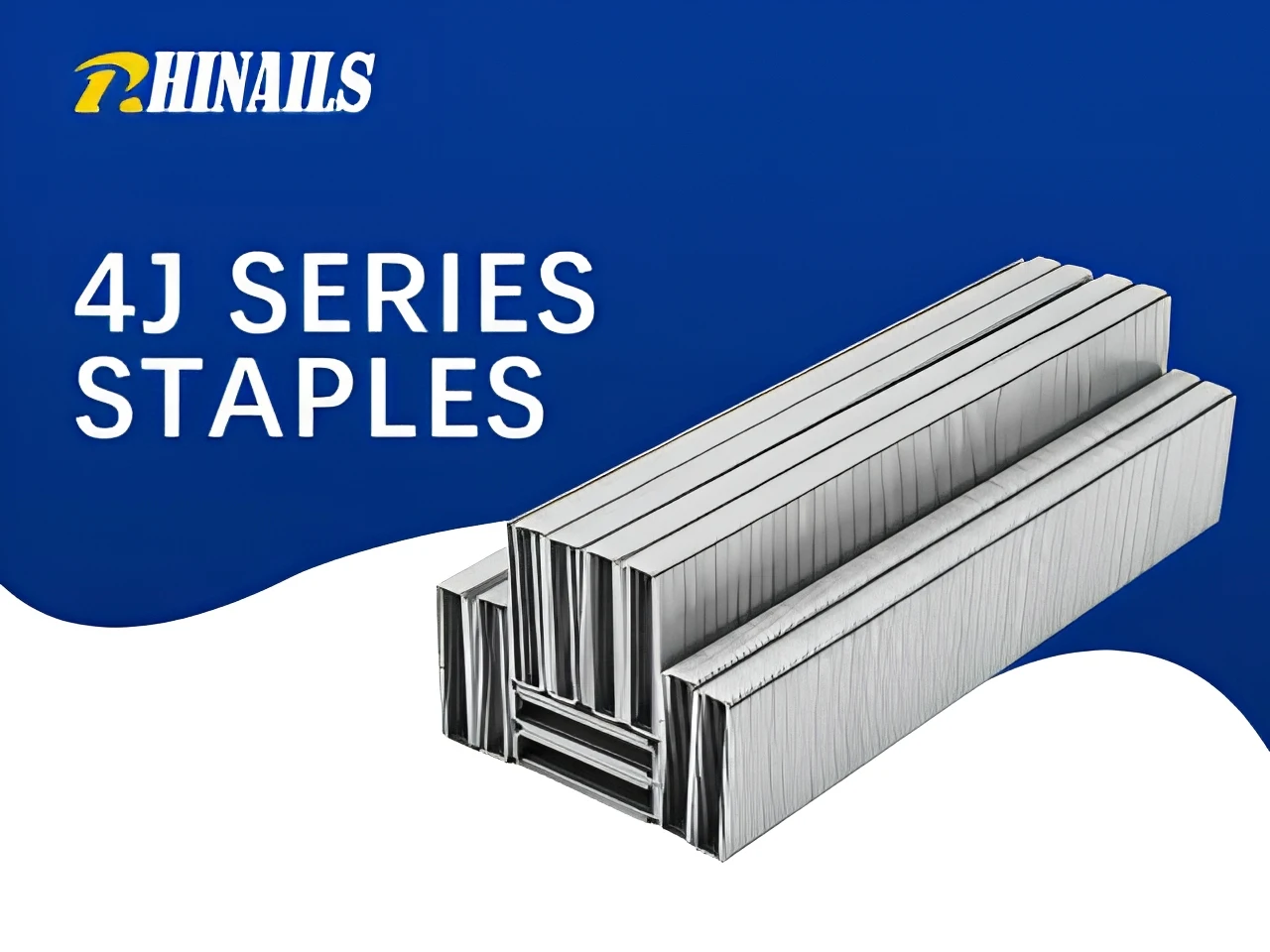
Fig. 3 - Rhinails 4J-series 20-gauge staples: 5.0 mm narrow crown profile engineered for tight corner joinery, picture framing, and detailed furniture molding.
In dense manufactured materials like high-density fiberboard (HDF), shoe insoles, and automotive interior door cards, standard chisel wire blunts and crumples upon entry:
Standard wire points require excessive pneumatic pressure (over 100 psi) to pierce hardboard, which crushes surface fibers.
Rhinails 408K to 419K series U-type sharp staples are drawn from high-carbon steel wire (1.20 mm diameter, 11.20 mm crown) with razor-sharp needle-ground points.
The symmetrical piercing tips slice cleanly through hard composite substrates with 20% lower driving pressure, eliminating surface cratering and tool nose recoil.
Woodworking Application | Panel / Framing Substrate | Primary Failure Risk | Recommended Point Geometry | Recommended Staple Series |
Cabinet Back Panels | 1/4 in Plywood into 3/4 in Rabbet | Face blowout / punch-through | Divergent Point (DP) | 18-Gauge 90/K-Series or 4J-Series |
End-Grain Miter Joints | Picture frames, casing corners | Fastener slipping out of grain | Divergent Point (DP) | 20-Gauge 4J-Series or 10J-Series |
Heavy Sofa Frame Joints | 3/4 in Solid Oak / Hard Maple | Staple leg bending / buckling | Standard Chisel Point (CP) | 16-Gauge N-Series or 20-Gauge 10J |
Thin Furniture Edge Banding | 1/8 in Veneer / solid edge strip | Edge splitting & tear-out | Outside Chisel Point (OCP) | 22-Gauge 10F-Series or 71-Series |
Automotive Door Cards & HDF | 1/8 in High-density hardboard | Blunt staple buckling in nose | U-Type Sharp Point (408K-419K) | Rhinails High-Carbon Sharp Series |
Light Fabric Upholstery | Foam + woven fabric to pine frame | Fabric tearing at entrance | Standard Chisel Point (CP) | 22-Gauge 10F-Series or 71-Series |
Thirty years of industrial wire fastener manufacturing highlights four technical controls commercial buyers should verify:
Bevel Symmetry and Grinding Cleanliness: An uneven bevel angle on chisel staples steers legs off-axis, creating random divergence where parallel drive is required.
Point Sharpness without Wire Burrs: Stamped shear burrs on staple tips catch in tool nose guides, causing intermittent jams in high-speed upholstery tools.
Controlled Wire Tensile Hardness: Divergent staples require specific wire temper (800 to 950 N/mm2) so the legs flare smoothly without snapping under bending stress.
Collation Glue Resilience: The bonding adhesive must hold strips rigid in transit but shear cleanly at the crown shoulder without gumming up tool driver blades.
22-gauge 10F fine wire staples - 10F-Series Staples Collection
20-gauge 10J medium crown staples - 10J-Series Staples Collection
20-gauge 4J narrow crown staples - 4J-Series Staples Collection
21-gauge 80-series upholstery staples - 80-Series Staples Collection
Complete staple product catalogue - All Rhinails Staple Series
Q: What is the difference between chisel point and divergent point staples?A: Chisel point staples have identical bevels that drive legs straight and parallel for deep solid hardwood penetration. Divergent point staples have opposite bevels that force legs to flare outward into an arc, creating an anchor hook in thin plywood and end-grain. |
Q: Why do divergent point staples hold better in end-grain?A: End-grain wood cells run parallel like vertical straws. Straight chisel staples slide between fibers easily, while divergent staples curl across the growth rings, anchoring into multiple cell walls for up to 45% higher pull-out strength. |
Q: How do divergent staples stop cabinet backs from blowing out?A: When driven into thin 1/4 in plywood rabbets, divergent legs immediately flare sideways across the veneer layers instead of driving straight through, keeping the sharp fastener tips contained safely inside the wood core. |
Q: What are U-type sharp point staples (408K-419K) used for?A: U-type sharp staples feature needle-ground conical points forged from high-carbon steel. They are engineered to pierce dense high-density fiberboard (HDF), shoe insoles, and automotive door cards with 20% lower pneumatic pressure. |
Q: What is an outside chisel point staple?A: An outside chisel staple has bevels ground on the inside faces of both legs, forcing the tips to curve inward toward each other upon entry, pinching the wood fibers tightly between the legs for miter joint reinforcement. |
Rhinails is a high-precision wire fastener manufacturer with 30 years of industrial export experience, supplying certified collated staples, brad nails, finish fasteners, and pneumatic tools to commercial cabinetmakers, furniture manufacturers, and hardware distributors worldwide. We produce 10F, 10J, 4J, 80, 90, N, and P-series staples in standard chisel, divergent point, and specialized U-type high-carbon sharp configurations cold-drawn from premium carbon steel and Grade 304 stainless steel. Every production lot undergoes rigorous tip-angle microscopic inspection, penetration drive testing, and withdrawal load verification. Contact us to request technical specification sheets, container-load wholesale pricing, or jobsite evaluation sample packs.


