
- All
- Product Name
- Product Keyword
- Product Model
- Product Summary
- Product Description
- Multi Field Search
Views: 0 Author: Rhinails Fasteners Publish Time: 2026-10-09 Origin: Site


Roofing nails back out because timber and OSB roof decking expand and contract with temperature and humidity cycling, which slowly pushes a smooth-shank fastener out of the deck.
On high-wind exposures, coastal properties, or steep-pitch roofs, upgrade to ring-shank coil roofing nails: the annular rings bite into the timber grain and deliver more than double the withdrawal resistance of smooth shank.
Pair that shank with the right coating: hot-dip galvanized (HDG) with 45 to 85 microns of zinc for standard 20- to 30-year roofs, 304 or 316 stainless steel for coastal salt air or copper valley flashing, and keep thin electro-galvanized fasteners away from exterior roof decks entirely.
Ask any roofing contractor what causes nail pops after five or seven years, and the answer is rarely the shingle itself. The problem sits underneath, inside the plywood or OSB roof deck.
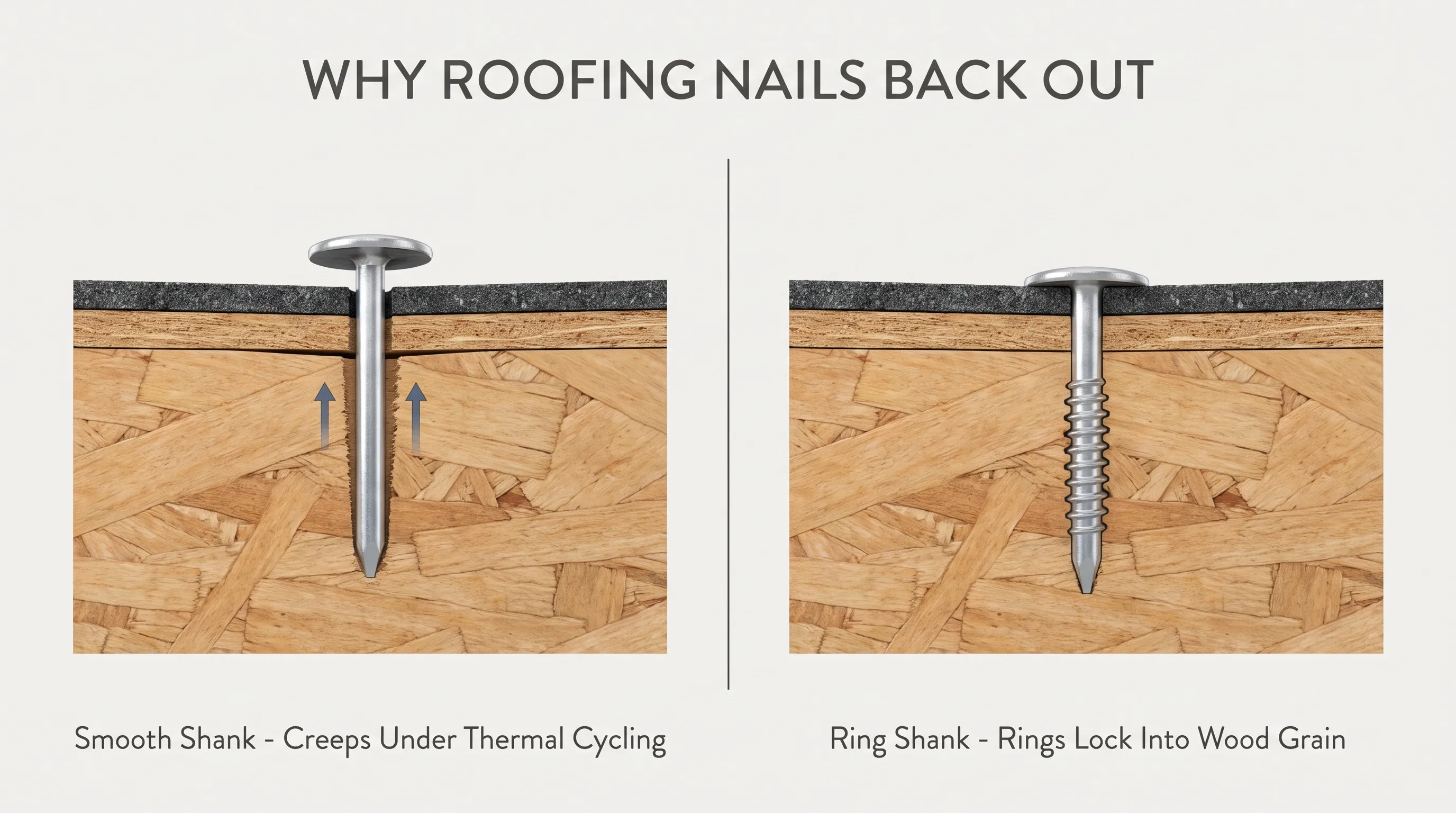
Fig. 1 - Smooth-shank nails creep upward as roof decking cycles through temperature and humidity changes. Ring-shank nails lock annular rings into the wood grain.
A roof deck is an active surface. Daily thermal swings between direct afternoon sun and cool nights, combined with attic humidity, cause wood fibers to swell and shrink continuously.
Wood expands across the grain, compressing against the smooth steel shank.
Wood shrinks back during dry or cold periods, relaxing its grip on the smooth surface.
Wind uplift creates repeating negative pressure over the shingle tabs, tugging upward on the nail head.
With each expansion-relaxation cycle, the smooth shank ratchets upward a fraction of a millimeter.
Within 5 to 10 years, the nail head stands "proud," pushing the shingle tab above it until it punctures the asphalt mat and creates a leak point.
Specification / Property | Smooth Shank Roofing Nails | Ring Shank (Annular) Roofing Nails |
|---|---|---|
Withdrawal resistance (ASTM D1761) | Baseline reference | 200% to 280% higher than smooth shank in OSB/plywood |
Holding mechanism | Friction between wood fibers and smooth steel | Mechanical interlock; wood fibers expand into the ring grooves |
Response to deck expansion/contraction | Creeps upward over seasonal thermal cycles | Rings resist upward movement; stays seated flush |
Driving effort into dense decking | Lower driving resistance; easier on older tools | Slightly higher driving resistance; requires proper air pressure (70-90 psi) |
Recommended roof applications | Low-wind, single-story inland roofs, temporary structures | High-wind zones (over 110 mph), coastal regions, steep slopes, architectural shingles |
Applicable product formats | Collated wire coils, plastic strips, bulk hand-drive | Wire coil roofing nails, paper-collated, electro/HDG/stainless |

Fig. 2 - Collated coil nails with deformed shanks: annular rings for withdrawal grip, spiral shanks for framing density.
For professional crews, the labor to strip and replace a wind-damaged roof section costs twenty to fifty times more than the fastener price difference. Upgrading from smooth to ring shank on coil nail lines is the most cost-effective insurance against nail pops.
The second fatal mistake on roofs is coating confusion. Both electro-galvanized (EG) and hot-dip galvanized (HDG) nails look silvery when brand-new in the box. But roofers who have had to repair 7-year-old shingles know why contractors on trade forums refer to electro-galvanized roofing fasteners as "the rustmaster 2000."
Coating Type | Zinc Thickness | ASTM Standard | Salt Spray Hours (ASTM B117) | Expected Outdoor Roof Lifespan |
|---|---|---|---|---|
Electro-Galvanized (EG) | 5 to 8 microns (0.2-0.3 mils) | ASTM A641 / F680 | 24 to 48 hours to red rust | 2 to 5 years outdoors; rusts rapidly under damp underlayment |
Hot-Dip Galvanized (HDG) | 45 to 85 microns (1.8-3.4 mils) | ASTM A153 Class D | 1,000+ hours | 20 to 30+ years; matches 30-year architectural shingle warranties |
Grade 304 Stainless Steel | Solid alloy (18% Cr, 8% Ni) | ASTM F593 / A276 | 2,000+ hours | 50+ years; standard for coastal within 15 miles of saltwater |
Grade 316 Stainless Steel | Solid alloy (16% Cr, 10% Ni, 2% Mo) | ASTM F593 / A276 | 3,000+ hours | Lifetime; marine splash zones, severe industrial atmospheres |
Electro-galvanizing is an indoor process: an electrical bath deposits a microscopic zinc film onto the steel wire. As soon as morning dew, condensation beneath shingles, or wind-driven rain penetrates the shingle keyways, that 5-micron layer oxidizes through in months.
Hot-dip galvanizing immerses clean steel fasteners in molten zinc at roughly 450 degrees Celsius. The molten zinc reacts with the steel surface to form several distinct iron-zinc alloy layers beneath a pure zinc outer layer.
Even if the outer zinc layer is scratched by the nailer driver blade during firing, the underlying alloy layers and cathodic protection prevent rust from eating the steel core.

Fig. 4 - Smooth shank coil nails: ideal for indoor pallets, crating, and dry framing where wind uplift and weather exposure are absent.
One specific scenario accounts for some of the most expensive roofing warranty claims: using galvanized nails to fasten copper valley flashing, copper step flashing, or copper drip edges.
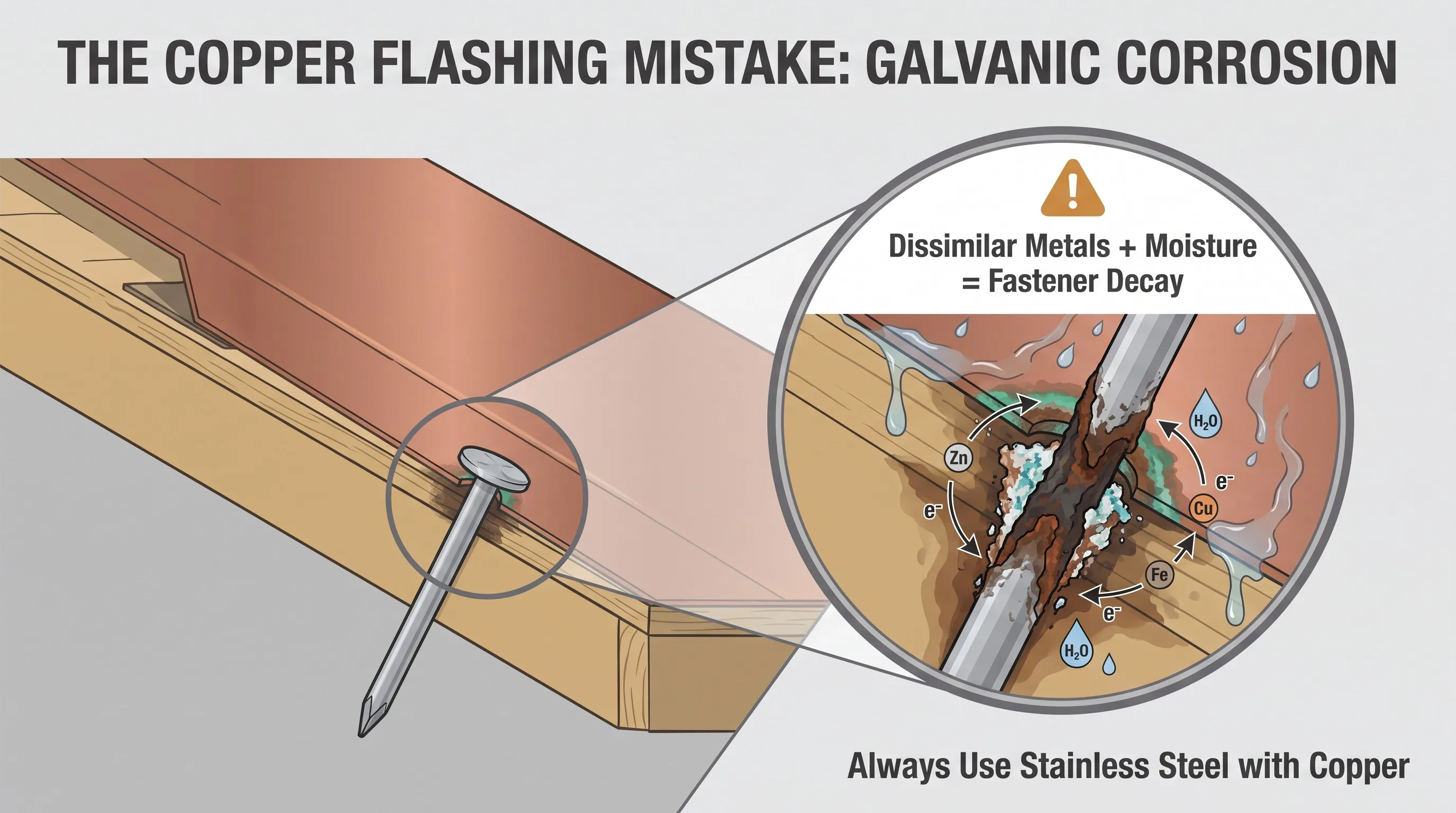
Fig. 4- Galvanic corrosion: when zinc/steel fasteners contact noble copper in the presence of rainwater, the fastener becomes the sacrificial anode and corrodes rapidly.
According to the galvanic series of metals:
Zinc and carbon steel sit at the active (anodic) end.
Copper sits near the passive (cathodic/noble) end.
Rainwater running down a roof valley acts as the electrolyte completing the circuit.
When a galvanized nail is driven through a copper flashing sheet, the vast surface area of the noble copper acts as a cathode, while the tiny surface area of the nail shank and head acts as the sacrificial anode. The zinc coating is consumed in months, followed by rapid corrosion of the steel nail shank. Within three to five years, the nail head rusts off completely, the valley flashing lifts during windstorms, and dark rust wash discolors the copper patina.
The rule is simple: Always fasten copper roof flashings with solid copper nails or Grade 304/316 stainless steel fasteners. Never use galvanized, electroplated, or bright steel nails with copper.
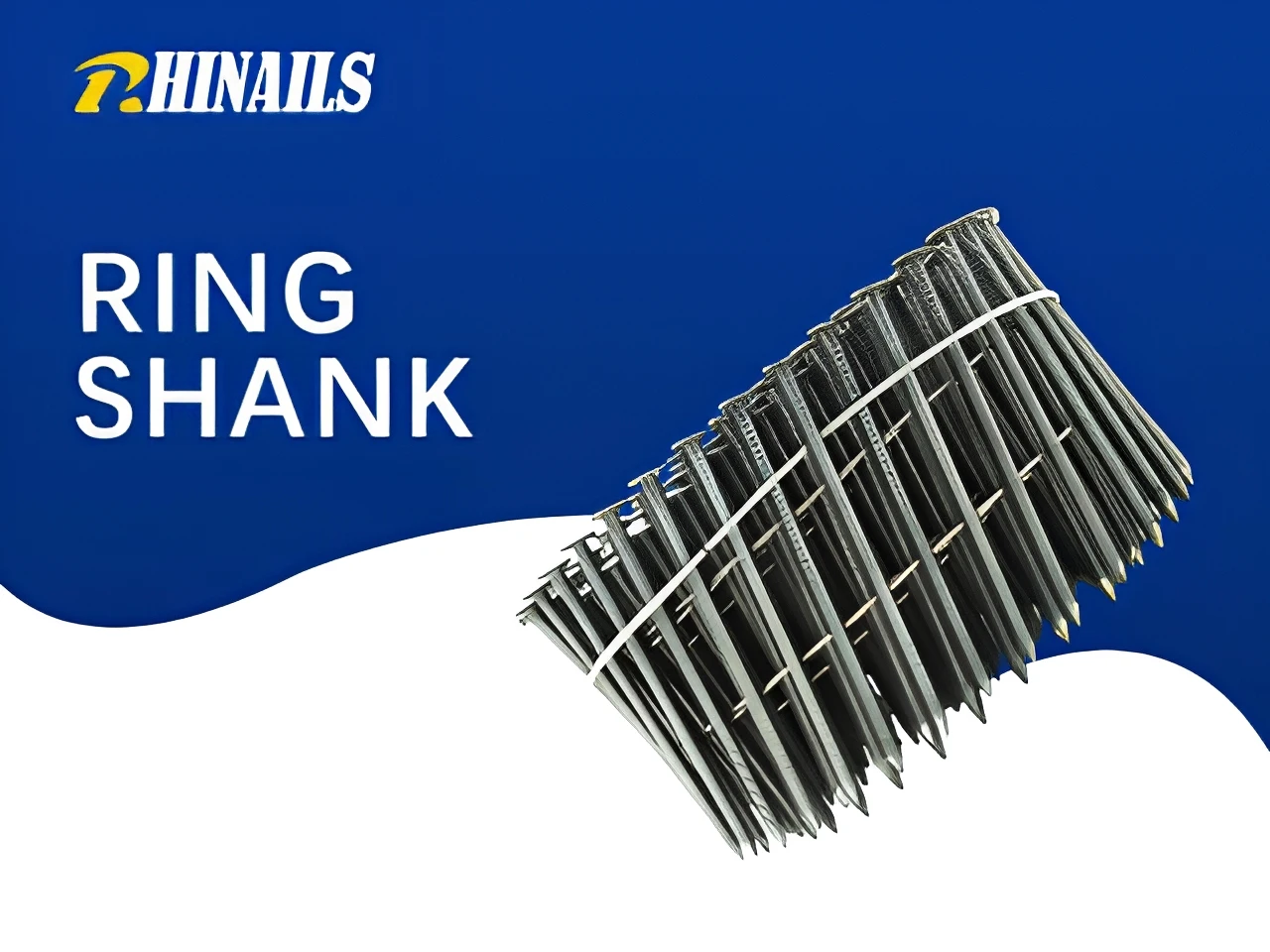
Fig. 6 - Ring shank coil nails with heavy zinc protection: the professional standard for residential roof replacement.
Roofing Project Environment | Recommended Shank | Minimum Coating Spec | Typical Wire Gauge & Length |
|---|---|---|---|
Inland standard slope (single-family home) | Smooth or Ring Shank | Hot-Dip Galvanized (ASTM A153 Class D) | 11 or 12 gauge, 1-1/4 in to 1-1/2 in |
High-wind inland (gusts > 100 mph, open terrain) | Ring Shank | Hot-Dip Galvanized (ASTM A153 Class D) | 11 gauge, 1-1/4 in to 1-3/4 in |
Coastal zone (within 15 miles of salt water) | Ring Shank | Grade 304 or 316 Stainless Steel | 11 gauge, 1-1/4 in to 1-1/2 in |
Roof valleys & step flashings (Copper) | Smooth or Ring Shank | Grade 316 Stainless or Solid Copper | 11 or 12 gauge, 1-1/4 in |
Cedar shingle & shake roofs (high tannin content) | Ring Shank | Grade 304/316 Stainless Steel | 13 or 14 gauge, 1-1/2 in to 2 in |
Commercial flat roof base sheet / recovery board | Ring Shank | Heavy Galvanized or Polymer-coated | 11 gauge, 1-1/4 in to 2-1/2 in |
Verify head diameter (9.5 mm / 3/8 in minimum). A roofing nail must hold the fiberglass mat without tearing through. Check that head stamping is centered and free of cold-shut cracks that snap off under pneumatic driver impact.
Specify ASTM A153 Class D for galvanized exterior fasteners. Reject generic descriptions like "plated" or "galvanized" without a coating thickness specification. A genuine hot-dip galvanized roofing nail carries at least 45 microns of zinc.
Check collation weld wire precision. Collated coil roofing nails rely on twin copper-coated weld wires at 15 or 16 degrees. Burrs, uneven spacing, or brittle welds create feed jams in high-speed coil guns like the CN45 or CN55. See our matched pneumatic coil nail gun line.
Demand salt spray test reports (ASTM B117). A reliable factory provides verifiable third-party test data demonstrating at least 1,000 hours without red rust for HDG and 2,000+ hours for stainless steel.
High-wind & exterior shingle fastening - Ring Shank Coil Nails Collection
Dry structural framing & crating - Smooth Shank Coil Nails Collection
Heavy framing, pallet building & timber joints - Spiral Shank Coil Nails Collection
Wire, mesh & agricultural perimeter roofing - Heavy Galvanized Fence Staples
Complete fastener catalogue - Rhinails Coil Nails Overview
Q: Why do roofing nails back out over time?
A: Wood roof decks expand and contract with seasonal humidity and daily temperature changes. Smooth-shank nails provide only friction against the wood grain, allowing the nail to ratchet upward a tiny amount with each cycle until the head pushes through the shingle. Ring-shank nails lock wood fibers into their annular grooves and resist this movement.
Q: Can I use electro-galvanized nails on an asphalt shingle roof?
A: Electro-galvanized (EG) nails carry only 5 to 8 microns of zinc and typically show red rust within 2 to 5 years when exposed to outdoor condensation under shingles. For standard 20- to 30-year asphalt shingles, always use hot-dip galvanized (HDG) nails with 45 to 85 microns of zinc or stainless steel.
Q: What nail shank is best for high-wind areas?
A: Ring-shank roofing nails are the industry standard for high-wind areas. They provide more than double the withdrawal resistance of smooth-shank nails, preventing shingles from pulling free during wind-uplift events.
Q: What nails should be used with copper roof flashing?
A: Always use solid copper nails or Grade 304/316 stainless steel nails with copper flashing. Using galvanized or carbon steel nails causes severe galvanic corrosion that destroys the fastener in a few seasons.
Q: What air pressure should a coil roofing nailer run at?
A: Most pneumatic coil roofing nailers operate between 70 and 90 psi. Set the pressure and tool depth-of-drive so the nail head sits flush with the shingle surface without cutting into the asphalt mat. Overdriven nails cut the shingle fibers; underdriven nails create leaks.
Q: What length roofing nail do I need for standard shingles?
A: A 1-1/4 in (32 mm) nail is the standard choice for single-layer asphalt shingles over 1/2 in plywood or 7/16 in OSB. For re-roofing over an existing layer or installing thick architectural shingles, move up to 1-1/2 in (38 mm) to ensure the nail shank penetrates at least 3/4 in into the decking or completely through.
Rhinails is a fastener manufacturer with 30 years of production experience supplying collated coil nails, roofing nails, staples, and pneumatic nailers to distributors, roofing contractors, and timber frame builders worldwide. We manufacture wire-collated and plastic-sheet coil nails in smooth, spiral, and ring shank profiles, finished with electro-galvanizing, hot-dip galvanizing (ASTM A153 Class D), and Grade 304/316 stainless steel. Every production lot is verified for head geometry, shank tolerance, and corrosion resistance. Contact us to request our roofing fastener specification sheet, salt spray test reports, or container-load OEM pricing.


