
- All
- Product Name
- Product Keyword
- Product Model
- Product Summary
- Product Description
- Multi Field Search
Views: 0 Author: Rhinails Publish Time: 2026-11-25 Origin: Site


The building code standard for framing 2x4 wall studs is a 16d nail: use two 16d common nails (3-1/2 in x 0.162 in) or three 16d sinkers (3-1/4 in x 0.148 in) per stud end when end-nailing through top and sole plates (IRC Table R602.3(1)), and three 8d common nails (2-1/2 in x 0.131 in) or four 10d box nails driven at a 30-degree angle when toe-nailing.
Framing nailers accept wire diameters from 0.113 in (8d) to 0.162 in (16d common) across 21-degree plastic and 30-to-34-degree paper tape collation.
When assembling standard 2x4 wall framing (actual timber dimensions: 1-1/2 in x 3-1/2 in), the fastening method dictates the required nail size and quantity.

Fig. 1 - Rhinails paper strip framing nails: 30-degree to 34-degree collated wire nails designed for high-speed pneumatic framing guns, manufactured to strict ASTM F1667 tolerances.
The two primary joint configurations are:
End-Nailing (Wall framed flat on the subfloor): Nails drive straight through the 1-1/2 in plate into the end-grain of the 2x4 stud. Code requires two 16d common nails (0.162 in) or three 16d box/sinker nails (0.131 in to 0.148 in) per connection.
Toe-Nailing (Installing studs into existing standing walls): Nails drive at roughly a 30-degree angle, starting 1 in above the base and penetrating 3/4 in into the plate. Code requires three 8d common nails (2-1/2 in x 0.131 in) or four 10d box nails (3 in x 0.128 in) per stud.
Unlike finish nailers which use whole gauge numbers (16-gauge or 18-gauge), pneumatic framing nailers specify fasteners by decimal shank diameter (inches or millimeters).
Framing Nail Callout | Decimal Shank Diameter | Approximate Wire Gauge | Nominal Length | Common Jobsite Role |
8d Common | 0.131 in (3.33 mm) | 10-gauge wire | 2-1/2 in (64 mm) | Wall sheathing (OSB/Plywood), toe-nailing 2x4 |
8d Cooler / Box | 0.113 in (2.87 mm) | 11.5-gauge wire | 2-3/8 in (60 mm) | Roof deck sheathing, non-bearing partitions |
10d Common | 0.148 in (3.76 mm) | 9-gauge wire | 3 in (76 mm) | Double top-plates, rim joists, framing clips |
10d Box / Short | 0.120 in (3.05 mm) | 11-gauge wire | 3 in (76 mm) | Interior non-load-bearing wall stud framing |
16d Sinker | 0.148 in (3.76 mm) | 9-gauge wire | 3-1/4 in (83 mm) | Primary commercial 2x4 & 2x6 production framing |
16d Common | 0.162 in (4.11 mm) | 8-gauge wire | 3-1/2 in (89 mm) | Code-mandated shear walls, earthquake hold-downs |
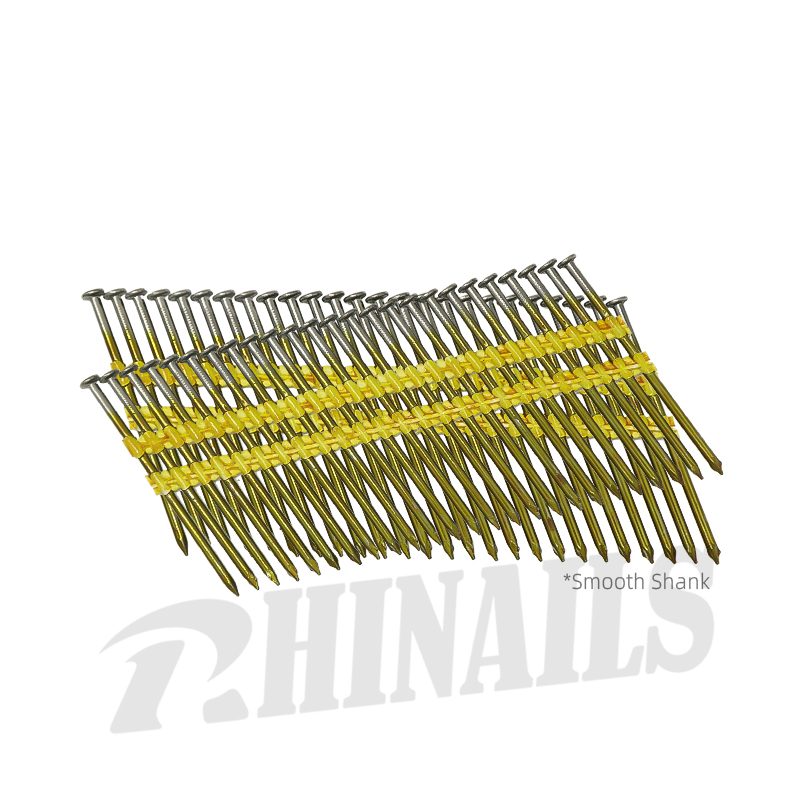
Fig. 2 - Rhinails 21-degree plastic strip framing nails: full round head nails engineered to satisfy hurricane-zone and high-seismic building codes.
A critical jobsite distinction: most standard 30-degree paper tape framing nailers shoot up to 0.131 in or 0.148 in shank diameters. Driving a true 0.162 in (16d common) nail requires a heavy-duty framing nailer specifically rated for 0.162 in wire.
In residential wood framing across North America, carpenters drive 16d sinkers on roughly 80% of jobs:
True 16d Common (3-1/2 in x 0.162 in): Delivers maximum lateral shear capacity (140+ lbs per nail). Required by structural engineers for hurricane tie-downs and shear wall hold-down hardware.
16d Sinker (3-1/4 in x 0.148 in): Slightly shorter and thinner. Easier to drive with less air consumption, causes fewer split stud ends, and carries a friction-melt vinyl coating that bonds to wood fibers to deliver high withdrawal resistance.
Sourcing Certified Framing Nails Direct from Factory?Rhinails produces ASTM F1667 compliant 21-degree plastic and 30-34 degree paper tape framing nails in 0.113", 0.120", 0.131", 0.148", and 0.162" diameters with full round heads and hot-dip galvanized options. Request a Framing Nail Specification Sheet & Free Sample Pack -> |
Framing Connection Joint | Fastener Size & Type | Minimum Number of Fasteners | Nailing Method |
2x4 Stud to Sole Plate | 16d common (0.162") OR 16d sinker (0.148") | 2 common OR 3 sinkers | End-nail through plate |
2x4 Stud to Sole Plate | 8d common (0.131") OR 10d box (0.128") | 3 common OR 4 box | Toe-nail at 30 degrees |
Top Plate to Stud | 16d common OR 16d sinker | 2 common OR 3 sinkers | End-nail through plate |
Double Top Plate Lap Joint | 16d common OR 16d sinker | 2 at each splice | Face-nail |
Double Top Plate to Lower Plate | 10d common (0.148") OR 16d sinker | 1 nail every 16 in OC | Face-nail along plate |
Built-Up Header (Two 2x Members) | 16d common (0.162") | 16 in OC along each edge | Face-nail opposite sides |
Joist to Sill or Girder | 8d common (0.131") | 3 nails | Toe-nail |
Corner Studs (3-Stud Post) | 10d common OR 16d sinker | 24 in OC along stud | Face-nail studs together |
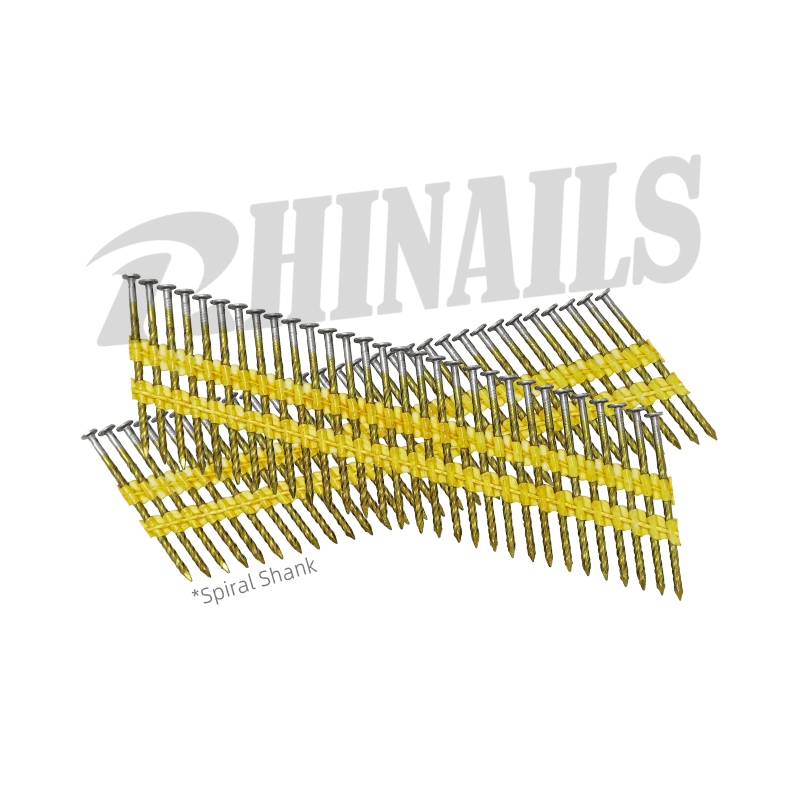
Fig. 3 - Rhinails spiral shank plastic strip nails: deformed spiral flutes provide mechanical interlock against cyclic wind vibration and timber racking loads.
When purchasing pneumatic framing nails, match the collation angle to your tool:
21-Degree Plastic Collated: Fires true full round head nails. Plastic strips are waterproof for wet winter framing jobs. Tool magazine holds ~60 nails.
30-to-34-Degree Paper Tape Collated: Nails are tightly nested, fitting ~80 nails per stick. The steep magazine angle allows the tool nose to fit between tight 16 in OC wall studs without awkward tilting.
Thirty years of industrial nail manufacturing highlights four technical controls commercial buyers should verify:
Certified Carbon Wire Caliber (+/- 0.01 mm): Reject bargain nails drawn undersized (0.120 in sold as 0.131 in). Rhinails draws certified Q235 and 1022A carbon wire through diamond dies.
Concentric Full Round Head Stamping: The nail head must be cold-forged centered over the shank centerline so pneumatic driver blades deliver balanced impact without bending the shank.
Moisture-Resistant Collation Bonding: Paper tape must hold strips rigid when wet, yet shear cleanly at the head shoulder without jamming tool driver guides.
ASTM A153 Class D Hot-Dip Galvanizing: Framing nails connecting treated sill plates (Mud Sills) to concrete must carry at least 45 microns of zinc to resist ACQ chemical corrosion.
Difference Between Common Nails and Box Nails: Shank & Shear Guide
The Real Cost of Cheap Framing Nails: Why Bargain Fasteners Cost More
16-Gauge vs 18-Gauge Finish Nailer: Which Do You Need for Trim?
30-34 degree paper tape framing nails - Paper Strip Nails Collection
21-degree plastic collated framing nails - Plastic Strip Nails Collection
High-capacity wire coil framing nails - Coil Nails Overview
Pneumatic framing and coil nailers - Rhinails Pneumatic Tool Range
All structural fasteners - Rhinails Complete Catalogue
Q: What size nails do I need for framing 2x4 walls?A: Use 16d nails (3-1/2 in x 0.162 in common or 3-1/4 in x 0.148 in sinker). End-nailing requires two 16d common or three 16d sinkers per stud end; toe-nailing requires three 8d common nails (2-1/2 in) at 30 degrees. |
Q: What gauge nails does a framing nailer use?A: Framing nailers use decimal wire diameters from 0.113 in (8d) to 0.162 in (16d common). The most common production framing size is 0.131 in (10d) and 0.148 in (16d sinker). |
Q: Can I use 3-inch nails for framing 2x4s?A: Yes, for non-load-bearing interior partition walls or where three 10d nails (3 in x 0.148 in) are substituted under approved building code schedules. For structural exterior framing, 3-1/2 in 16d nails are standard. |
Q: Why do framers use 16d sinkers instead of 16d common nails?A: 16d sinkers (3-1/4" x 0.148") are slightly shorter and thinner than common nails (3-1/2" x 0.162"), driving faster with less timber splitting, while their vinyl coating melts under friction to deliver high holding grip. |
Q: How many nails per 2x4 stud end are required by code?A: Under IRC Table R602.3(1), end-nailing requires two 16d common nails (0.162") or three 16d box/sinker nails (0.148"/0.131") driven through the plate into each stud end. |
Rhinails is a structural fastener manufacturer with 30 years of global export experience, supplying certified 16d/10d/8d framing wire nails, paper tape nails, plastic strip nails, coil nails, and pneumatic tools to commercial lumberyards and framing contractors worldwide.
We produce high-tensile carbon steel nails with bright, electro-galvanized, and hot-dip galvanized (ASTM A153 Class D) finishes engineered to IRC Section R602.3 structural standards.
Every production lot undergoes strict dimensional tolerance inspection, shear-load testing, and jam-free pneumatic firing verification.
Contact us to request technical specification sheets, container-load wholesale pricing, or jobsite evaluation sample packs.


